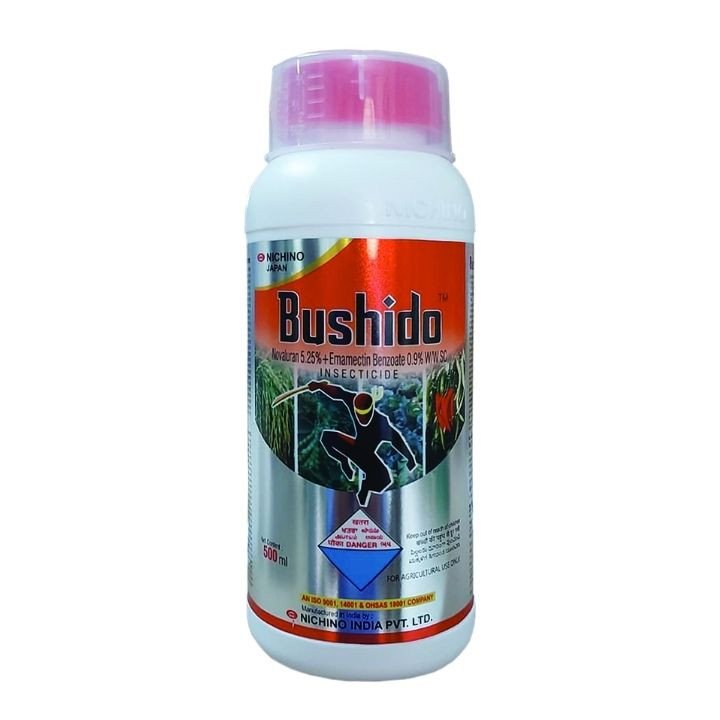
The frustrating thing about lepidopteran pests — stem borers, pod borers, diamondback moth — is that they don't just cause damage; they hide inside plant tissue or under leaf cover, making a single mode of action often insufficient on its own. Nichino Bushido was formulated around this exact challenge, combining Novaluron 5.25% and Emamectin Benzoate 0.9% in an SC, deliberately structured to give growers both a fast initial knockdown and extended residual protection from the same spray.
What's notable about Bushido isn't just its dual chemistry, but how broad its label registration is. Rather than being tied to a single crop-pest combination, it carries claims across rice, chilli, red gram, and cabbage — targeting a different but equally damaging lepidopteran pest in each case, which gives it genuine flexibility for farms growing more than one of these crops.
| Detail | Specification |
|---|---|
| Brand | Nichino India |
| Product Name | Bushido |
| Active Ingredients | Novaluron 5.25% + Emamectin Benzoate 0.9% |
| Formulation | Suspension Concentrate (SC) |
Novaluron is an insect growth regulator — it disrupts chitin synthesis, which interferes with the pest's ability to molt and develop normally through its larval stages. This is a slower-acting but persistent mechanism, contributing to the product's long duration control. Emamectin Benzoate, on the other hand, acts on the insect's nervous system, binding to chloride channels and causing rapid paralysis — this is what gives Bushido its quick knockdown effect. Together, the fast-acting and slow-developing mechanisms cover both the immediate infestation and the pest's ability to complete its life cycle.
| Crop | Target Pest | Dose (per Acre) |
|---|---|---|
| Rice | Stem Borer | 600 ml |
| Chilli | Pod Borer | 350 ml |
| Red Gram (Tur) | Fruit Borer | 350 ml |
| Cabbage | Diamondback Moth | 350 ml |
Notice that rice carries a noticeably higher dose than the other three crops — this reflects the difference in how stem borer behaves compared to pod borer, fruit borer, and diamondback moth, since stem borer larvae tunnel inside the rice stem itself, requiring a stronger application rate to achieve adequate control compared to pests feeding more externally on foliage or pods.
Rainfastness matters more than most farmers initially realize — a fungicide or insecticide that washes off within an hour of rainfall essentially wastes the application entirely, forcing an unplanned repeat spray. Bushido's rainfast property means unexpected rain shortly after spraying is less likely to compromise the treatment, which is a genuine practical advantage during monsoon-adjacent cropping windows when rain timing is hard to predict.
Both active ingredients in Bushido are generally associated with a favorable safety profile toward pollinators, beneficial insects, and the person doing the spraying — a meaningful consideration given how much manual spraying still happens across Indian farms. This isn't unique to Bushido alone, but it's a relevant factor when choosing between products with otherwise similar target-pest coverage.
Why does rice need almost double the dose used for chilli, red gram, or cabbage?
Stem borer larvae tunnel inside the rice stem, which is harder to reach and control compared to pests like pod borer or diamondback moth that feed more externally — this biological difference is reflected in the higher labeled dose.
If it rains right after I spray, do I need to reapply?
Bushido's rainfastness property generally reduces the need for immediate reapplication after light rainfall, though very heavy rain shortly after spraying may still warrant reassessment.
Which of the two active ingredients acts faster — Novaluron or Emamectin Benzoate?
Emamectin Benzoate provides the faster knockdown by disrupting nerve function directly, while Novaluron works more gradually by interfering with the pest's molting process, contributing to longer-term control.
Is Bushido safe to use if my field has active pollinator activity?
It's associated with relative safety to pollinators and beneficial insects when applied as per label recommendation, though standard precautions around spray timing near flowering periods are still advisable.
Disclaimer: The details provided are for informational guidance only. Always adhere to the recommended application instructions as stated on the product label and in the accompanying leaflet.
No reviews yet.