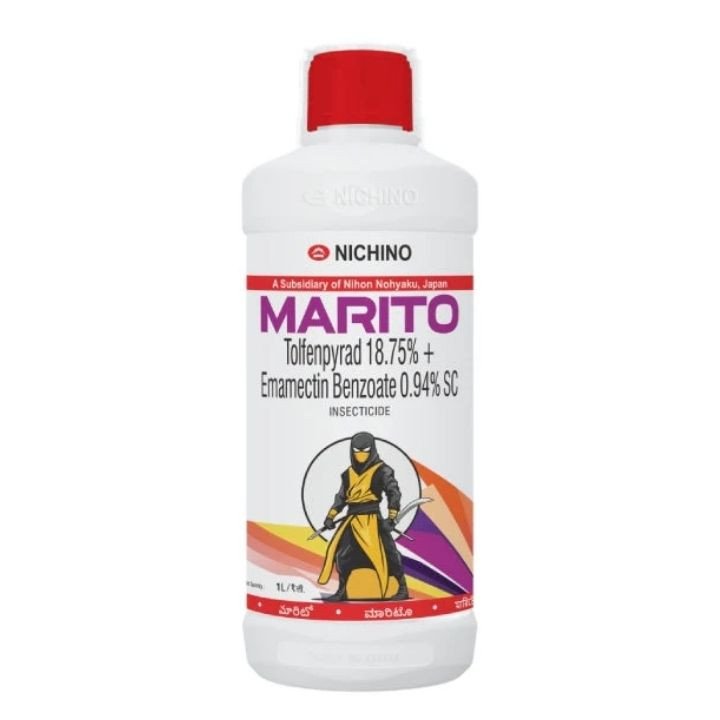
Most insecticides get judged by how well they knock down adult pests already visible on the crop — but by the time an infestation is visible, a portion of the damage is often already locked in through eggs waiting to hatch. NICHINO Marito takes a different angle, built around Tolfenpyrad 18.75% and Emamectin Benzoate 0.94% in a co-formulated SC, currently under patent process. Its standout trait isn't just pest knockdown — it's strong ovicidal action, meaning it interferes with pests at the egg stage before the next generation even gets started.
This matters most for pests notorious for rapid, overlapping generations — pink bollworm (PBW), brinjal shoot and fruit borer (BSFB), diamondback moth (DBM), and pinworm all fall into this category, where controlling adults alone without addressing eggs leaves a farmer perpetually a step behind the pest cycle.
| Detail | Specification |
|---|---|
| Brand | Nichino India |
| Product Name | Marito |
| Active Ingredients | Tolfenpyrad 18.75% + Emamectin Benzoate 0.94% |
| Formulation | Suspension Concentrate (SC) |
| Toxicity Classification | Yellow (Moderately Hazardous) |
| Registered Crops | Brinjal, Cauliflower |
Tolfenpyrad belongs to the METI group (Mitochondrial Electron Transport Inhibitor) — it disrupts the insect's cellular respiration, essentially cutting off its energy supply. Emamectin Benzoate works entirely differently, binding to glutamate-gated chloride channels in nerve and muscle cells, which increases chloride ion flow and hyperpolarizes the cell membrane, disrupting nerve signal transmission and leading to paralysis. Because these two mechanisms are unrelated, the combination covers both sucking pests and lepidopteran caterpillars more thoroughly than either active could alone.
| Crop | Application Rate |
|---|---|
| Brinjal | 280 ml per acre |
| Cauliflower | 280 ml per acre |
Both registered crops share the same rate, which simplifies planning for growers managing both in rotation or in adjacent plots.
One practical advantage worth noting: being an SC (suspension concentrate) rather than an EC (emulsifiable concentrate), Marito doesn't carry the skin and eye irritation risk that solvent-heavy EC formulations often do. For anyone mixing and spraying by hand — which describes a large share of Indian field applications — this is a meaningful, if understated, safety improvement.
Interestingly, Marito's benefits extend beyond insect management into disease suppression — it's associated with some level of protection against powdery mildew, downy mildew, white rust, and anthracnose, alongside its core insecticidal role. This dual insect-and-disease benefit is unusual for a product primarily positioned as an insecticide, and it can reduce the number of separate sprays a grower needs to schedule across a season.
Nichino's own guidance for this product is unusually specific, built around what's referred to as the 3R principle — right dose, right time, right method. Equally important are the don'ts: Marito is not meant to be used as a curative spray on an already advanced infestation, more than two sprays per crop cycle should be avoided, and spraying should be skipped if rainfall is expected within the next 4–5 hours, since this can wash off the product before it has time to work.
Marito's broader value shows up in situations where secondary pest resurgence has been a recurring headache — after some insecticide sprays knock down primary pests, mites, whitefly, or aphid populations can spike as their natural predators get affected too. Marito's profile is associated with reducing this resurgence pattern, which in practice can mean fewer total sprays needed across a season, even though the upfront product cost per application might be higher than a basic single-active insecticide.
Can Marito be sprayed on a crop that already has a heavy, visible infestation?
It's specifically designed for preventive or early-stage use rather than as a curative spray — using it on an already advanced infestation goes against the product's intended application guidance.
Why is there a limit of two sprays per crop cycle?
This guidance is tied to resistance management and residue considerations; exceeding it isn't recommended even if pest pressure seems to persist.
What happens if it rains shortly after spraying?
Rainfall within 4–5 hours of application can wash away the product before it's fully absorbed, reducing effectiveness — checking the forecast beforehand is part of the recommended application practice.
Does the disease-suppression benefit mean I can skip a separate fungicide spray?
While Marito shows some associated benefit against diseases like powdery and downy mildew, it's primarily an insecticide, and a dedicated fungicide program should still be followed based on actual disease pressure in the field.
Disclaimer: The details provided are for informational guidance only. Always adhere to the recommended application instructions as stated on the product label and in the accompanying leaflet.
No reviews yet.