

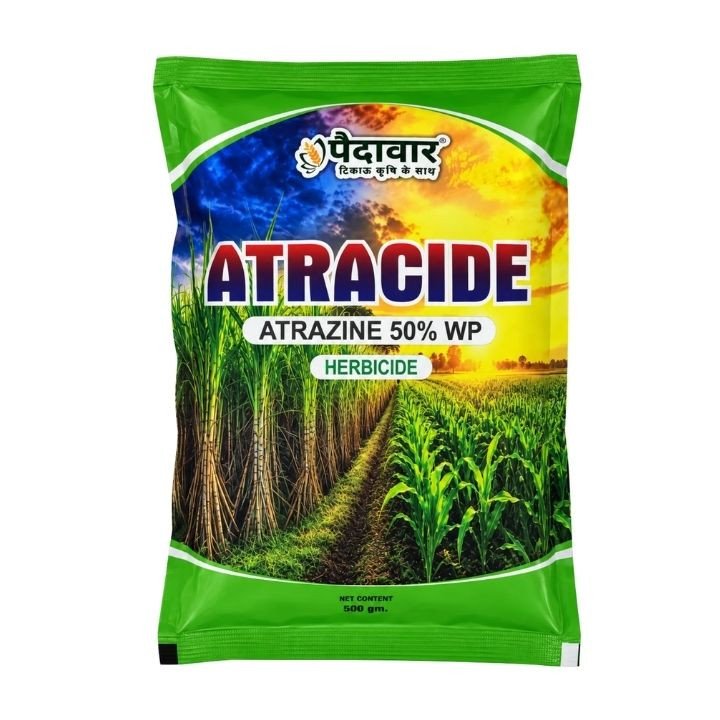
Paidavaar Atracide Herbicide (Atrazine 50% WP)
Paidavaar Atracide Herbicide (Atrazine 50% WP)
Paidavaar Atracide Herbicide is a selective pre-emergence herbicide containing Atrazine 50% WP. It is recommended for controlling important annual grassy and broadleaf weeds in maize and sugarcane during the early stages of crop establishment.
Atracide works by inhibiting photosynthesis in susceptible weeds. When applied at the recommended time after sowing or planting, it helps reduce early weed competition for nutrients, moisture, sunlight and growing space.
Product Specifications
| Product Name | Atracide |
| Brand | Paidavaar |
| Company | Sarvin Agro Chemicals Private Limited |
| KisanShop Category | Herbicide |
| Technical Composition | Atrazine 50% WP |
| Formulation | Wettable Powder (WP) |
| Herbicide Type | Selective Pre-Emergence Herbicide |
| HRAC Group | Group 5 |
| Mode of Action | Photosystem II Inhibitor |
| Recommended Crops | Maize and Sugarcane |
Technical Composition
Atrazine 50% WP
Atrazine is a selective herbicide belonging to HRAC Group 5. It inhibits electron transport in Photosystem II, disrupting photosynthesis in susceptible weeds. Affected weeds develop chlorosis followed by necrosis and eventual death.
Key Features
- Selective pre-emergence herbicide.
- Contains Atrazine 50% WP.
- Recommended for maize and sugarcane.
- Controls important annual grasses and broadleaf weeds.
- Provides early-season weed management.
- Helps reduce competition for water, nutrients, sunlight and growing space.
- Acts by inhibiting Photosystem II and photosynthesis.
- Best suited for application during the early crop-establishment period according to label directions.
Benefits of Paidavaar Atracide
- Early Weed Control: Helps prevent important weeds from establishing strongly during the critical early stages of crop growth.
- Grass Weed Management: Controls several important annual grassy weeds in registered crops.
- Broadleaf Weed Management: Provides control of multiple susceptible broadleaf weeds.
- Reduced Crop Competition: Helps crops access available nutrients, moisture and sunlight with less early weed competition.
- Selective Use: Registered for selective weed management in maize and sugarcane when used at the correct dose and crop stage.
Target Weeds in Maize
Registered Atrazine 50% WP use in maize includes weeds such as:
- Trianthema monogyna
- Digera arvensis
- Echinochloa species
- Eleusine species
- Xanthium strumarium
- Brachiaria species
- Amaranthus viridis
- Cleome viscosa
- Digitaria species
- Polygonum species
Target Weeds in Sugarcane
Registered Atrazine 50% WP use in sugarcane includes:
- Portulaca oleracea
- Digitaria species
- Boerhaavia diffusa
- Euphorbia species
- Tribulus terrestris
Recommended Crops & Dosage
| Crop | Target Weeds | Recommended Dose | Water Volume |
|---|---|---|---|
| Maize | Annual Grasses and Broadleaf Weeds | 1–2 kg/ha | 500–700 L/ha |
| Sugarcane | Annual Grasses and Broadleaf Weeds | 1–4 kg/ha | 500–700 L/ha |
Approximate acre-wise formulation rates are around 400–800 g per acre in maize and 400–1600 g per acre in sugarcane. Always follow the current Atracide label for the final crop-specific rate.
Application Timing
Atrazine 50% WP is registered as a pre-emergence herbicide. The registered label recommends application within 3 days after sowing or planting for maize and sugarcane.
Correct timing is important because Atracide is intended to control weeds during germination and early emergence rather than after they have become well established.
Mode of Action
Atrazine inhibits Photosystem II in susceptible weeds by blocking electron transport required for normal photosynthesis.
This stops the weed from producing energy efficiently. Susceptible plants gradually develop yellowing or chlorosis, followed by tissue necrosis and eventual death.
How to Use Paidavaar Atracide
- Prepare the field and complete sowing or planting.
- Apply within the crop stage recommended on the current product label.
- Measure the crop-specific quantity accurately.
- Prepare a smooth slurry using a small quantity of clean water.
- Add the slurry to the spray tank while maintaining agitation.
- Add the remaining required water and mix thoroughly.
- Apply uniformly over the soil surface using properly calibrated spraying equipment.
- Use a suitable flat-fan or flood-jet nozzle where recommended.
- Avoid excessive spray overlap and drift to neighbouring crops.
Application Tips
- Apply soon after sowing or planting according to label timing.
- Use uniform spray coverage across the soil surface.
- Do not disturb the treated soil unnecessarily after application.
- Use the crop-specific dose rather than one universal rate.
- Avoid spraying during rainy, windy or very hot sunny conditions.
- Use properly calibrated spraying equipment.
- Prevent spray drift onto sensitive neighbouring crops.
Re-Entry Period
The registered Atrazine 50% WP label specifies a 24-hour re-entry period after spraying. Follow any additional precautions stated on the current Atracide label.
Important Herbicide Precautions
Atracide is registered for maize and sugarcane. Do not assume that another crop is tolerant to Atrazine because crop sensitivity can differ significantly.
Do not use on crops other than those permitted on the current label. Avoid contamination of nearby water bodies and prevent drift onto non-target vegetation.
Resistance Management
Atrazine belongs to HRAC Group 5, the Photosystem II inhibitor group. Repeated use of herbicides with the same mode of action can select resistant weed populations.
Integrate Atracide with crop rotation, mechanical weed management and appropriately registered herbicides with different effective modes of action where needed.
Safety Precautions
- Read the complete product label and leaflet before use.
- Wear suitable gloves, protective clothing, footwear, eye protection and mask while mixing and spraying.
- Avoid inhaling formulation dust or spray mist.
- Avoid direct contact with skin and eyes.
- Do not eat, drink or smoke while handling the herbicide.
- Avoid contamination of ponds, streams and drinking-water sources.
- Keep children and animals away from the product and treated field according to label directions.
- Observe the recommended re-entry period.
Why Choose Paidavaar Atracide?
Paidavaar Atracide Herbicide with Atrazine 50% WP provides selective pre-emergence management of important grassy and broadleaf weeds in maize and sugarcane. Its Photosystem II inhibiting action helps reduce early weed competition during the critical crop-establishment stage.
Frequently Asked Questions
Q1. What is Paidavaar Atracide?
Atracide is a selective pre-emergence herbicide containing Atrazine 50% WP.
Q2. Which crops are recommended for Atracide?
Atrazine 50% WP is registered for maize and sugarcane.
Q3. What types of weeds does Atracide control?
It controls several susceptible annual grassy and broadleaf weeds in maize and sugarcane.
Q4. What is the dose in maize?
The registered recommendation is approximately 1–2 kg per hectare, equivalent to around 400–800 g per acre.
Q5. What is the dose in sugarcane?
The registered recommendation is approximately 1–4 kg per hectare, equivalent to around 400–1600 g per acre.
Q6. When should Atracide be applied?
The registered label recommends application within approximately 3 days after sowing or planting.
Q7. Is Atracide a post-emergence herbicide?
Paidavaar identifies Atracide as a selective pre-emergence herbicide.
Q8. How does Atrazine work?
Atrazine inhibits Photosystem II and blocks electron transport required for photosynthesis, resulting in chlorosis, necrosis and death of susceptible weeds.
Q9. What is the HRAC group of Atrazine?
Atrazine belongs to HRAC Group 5, the Photosystem II inhibitor group.
Q10. What is the re-entry period?
The registered Atrazine 50% WP label specifies approximately 24 hours after spraying.
Paidavaar Atracide Atrazine Herbicide for Maize and Sugarcane Weed Control
Paidavaar Atracide Herbicide contains Atrazine 50% WP for selective pre-emergence control of important annual grass and broadleaf weeds in maize and sugarcane through Photosystem II inhibition.
Disclaimer: The details provided are for informational guidance only. Always adhere to the recommended application instructions as stated on the product label and in the accompanying leaflet.
Similar Products
Best Selling
Customer Reviews
Recent Reviews
No reviews yet.