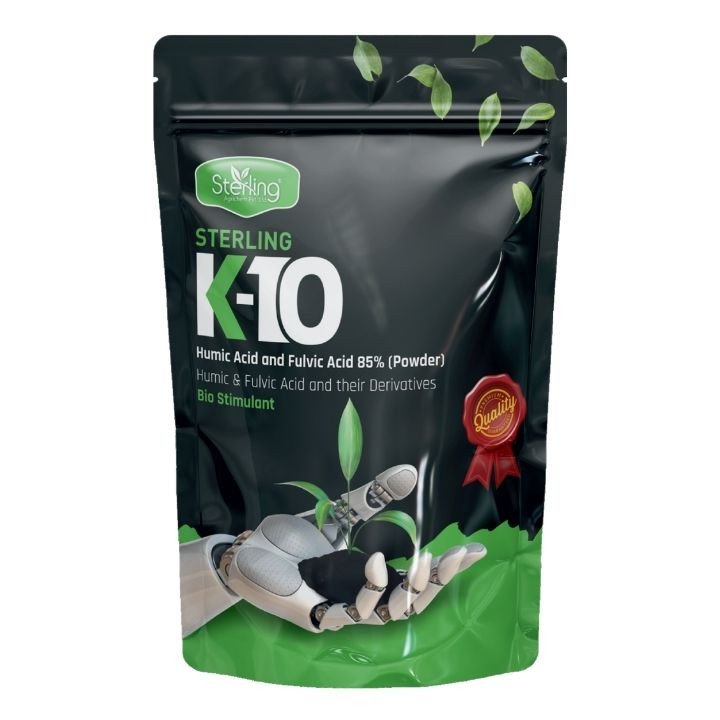
A surprising number of nutrient deficiency problems in the field aren't actually about insufficient fertilizer application — they're about soil conditions that prevent the plant from properly accessing nutrients that are already present. Sterling Agrichem's K-10 approaches crop improvement from exactly this angle. Built as a 98% water-soluble Potassium Humate product derived from oxidized leonardite extract, it works primarily by improving the soil environment itself, which in turn makes existing nutrients more available to the plant.
Leonardite, the raw material behind K-10, is a naturally oxidized form of lignite coal recognized for its high concentration of humic substances. The oxidation process is what unlocks the humic and fulvic acid content that gives this product its soil-conditioning properties, distinct from products derived from peat or other organic sources.
| Detail | Specification |
|---|---|
| Brand | Sterling Agrichem |
| Product Name | K-10 |
| Composition | Humic Acid and Fulvic Acid 85% |
| Form | Powder |
| Source Material | Oxidized Leonardite Extract |
| Solubility | 98% Water Soluble |
K-10's mode of action operates largely below what's visible above ground. It increases soil porosity, which improves aeration and root penetration through compacted soil layers, while simultaneously boosting the soil's water holding capacity — a meaningful benefit during dry spells or irregular irrigation scheduling. Together, these physical soil improvements support stronger root growth, which is the foundation for everything else the plant does above ground, from nutrient uptake to overall vigor.
| Crop Category | Primary Benefit Observed |
|---|---|
| All Crops | Improved soil health and nutrient uptake |
| Field Crops | Enhanced seed germination and root development |
| Horticulture | Better plant vigor and stress resistance |
| Orchard | Improved flowering and fruit set |
Unlike many biostimulants limited to a single application route, K-10 is flexible enough to be applied as a foliar spray, through drip irrigation, or directly to soil — and notably, the recommended dose changes depending on which method is used.
| Application Method | Recommended Dose |
|---|---|
| Foliar Spray | 100 gm per acre |
| Drip Application | 250 gm per acre |
| Soil Application | 250 gm per acre (can be combined with fertilizer) |
The lower foliar rate compared to drip or soil application reflects the more direct absorption pathway a foliar spray offers — the product reaches leaf tissue almost immediately, whereas drip and soil application need to work through the root zone and broader soil volume, which generally calls for a higher quantity to achieve comparable effect.
K-10's soil application method notably allows it to be combined directly with regular fertilizer application, rather than requiring a completely separate field pass. This can simplify scheduling for farmers already following a structured basal or top-dressing fertilizer program, letting K-10's soil-conditioning benefits ride alongside routine nutrition applications.
Why does the dose change depending on whether I use foliar, drip, or soil application?
Each method delivers the product through a different absorption pathway — foliar spray reaches leaf tissue directly at a lower dose, while drip and soil application work through the root zone and soil volume, generally requiring a higher quantity for comparable effect.
Can K-10 be mixed with my regular fertilizer application?
Yes, the soil application method specifically allows K-10 to be applied alongside fertilizer, simplifying the application schedule for farms already following a structured nutrition program.
What makes leonardite-based humic acid different from other sources?
Leonardite is a naturally oxidized lignite material recognized for its high humic substance concentration, and the oxidation process is specifically what makes its humic and fulvic acid content available in a form usable by this kind of product.
Is K-10 suitable for orchard crops specifically, or mainly field crops?
It's positioned across all crop categories, with orchard crops specifically noted for improved flowering and fruit set benefits alongside the broader soil health improvements seen across field and horticultural crops.
Disclaimer: The details provided are for informational guidance only. Always adhere to the recommended application instructions as stated on the product label and in the accompanying leaflet.
No reviews yet.