Dual-Action Protection Against Caterpillars and Sucking Insect Pests
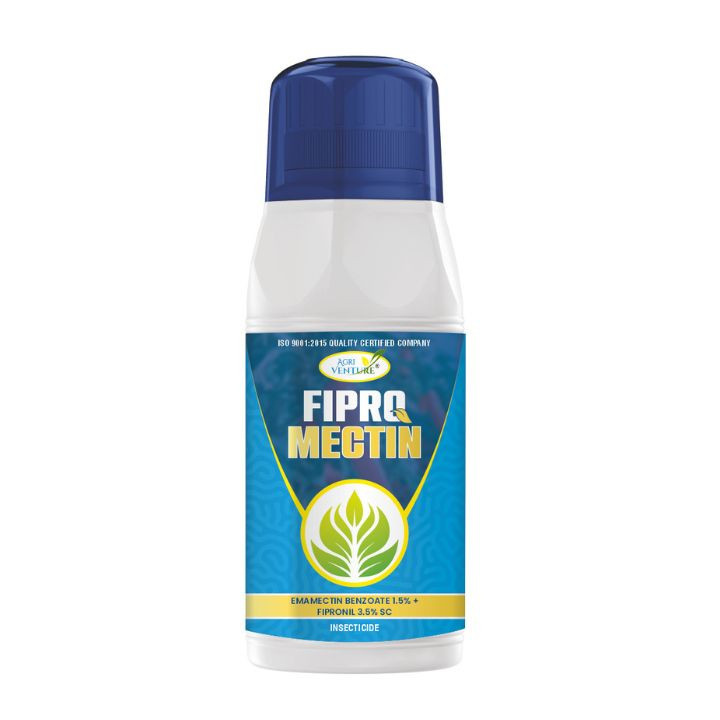
AGRIVENTURE FIPRO MECTIN is a broad-spectrum combination insecticide containing Emamectin Benzoate 1.5% + Fipronil 3.5% SC. It is formulated to control both chewing pests and sucking insects through contact, stomach and translaminar activity.
The combination rapidly stops caterpillar feeding while controlling pests such as bollworms, fruit borers, thrips, aphids, jassids and whiteflies. Its Suspension Concentrate formulation mixes easily with water and provides uniform crop coverage.
Product Specifications
| Product Name |
AGRIVENTURE FIPRO MECTIN |
| Brand |
AGRIVENTURE |
| Technical Content |
Emamectin Benzoate 1.5% + Fipronil 3.5% SC |
| Formulation |
Suspension Concentrate (SC) |
| Product Type |
Broad-Spectrum Dual-Action Insecticide |
| Mode of Application |
Foliar Spray |
| Recommended Dose |
1.3–1.5 ml per litre or 20 ml per 15 litres of water |
Key Features and Benefits
- Controls chewing and sucking pests in a single application.
- Provides contact, stomach and translaminar insecticidal activity.
- Reaches pests hiding on the lower surfaces of leaves.
- Causes caterpillars to stop feeding within a few hours.
- Helps control newly hatched larvae and reduce future pest populations.
- Effective against bollworms, fruit borers, thrips, aphids, jassids and whiteflies.
- Helps reduce repeated spray requirements when used at the correct stage.
- Suitable for important cash crops, vegetables, fruits and spices.
Recommended Crops
- Cash Crops: Cotton and sugarcane
- Vegetables: Chilli, tomato, okra, brinjal, onion, garlic and cabbage
- Fruits: Citrus, mango and pomegranate
- Spices: Cumin
Target Insect Pests
- Bollworms
- Fruit Borers
- Shoot Borers
- Caterpillars
- Thrips
- Aphids
- Jassids
- Whiteflies
Mode of Entry
- Contact Action: The insecticide enters the pest through direct contact with treated plant surfaces.
- Stomach Action: Pests are controlled after consuming treated foliage or plant tissues.
- Translaminar Action: The active ingredient moves through leaf layers to reach insects hiding beneath the foliage.
How AGRIVENTURE FIPRO MECTIN Works
Emamectin Benzoate primarily targets caterpillars and borers. It acts on chloride channels in insect nerve and muscle cells, resulting in rapid feeding cessation, paralysis and death.
Fipronil blocks GABA-regulated chloride channels in the insect nervous system. This causes uncontrolled nerve excitation, paralysis and mortality in sucking and chewing pests.
The two active ingredients work through different neurological pathways, providing broad-spectrum control and supporting insecticide resistance-management programmes.
Recommended Dose and Application
- Per litre of water: 1.3–1.5 ml
- Per 15-litre spray pump: 20 ml
- Apply as a uniform foliar spray at the first appearance of pest infestation.
- Cover both the upper and lower surfaces of leaves thoroughly.
- Use sufficient water to achieve complete crop-canopy coverage.
- Follow the crop-specific instructions printed on the product label.
Why Choose AGRIVENTURE FIPRO MECTIN?
- One solution for caterpillars and sucking pest complexes.
- Rapid feeding stoppage helps limit immediate crop damage.
- Translaminar movement controls pests hidden beneath leaves.
- Two active ingredients provide different modes of action.
- Suitable for cotton, sugarcane, vegetables, fruits and spice crops.
Frequently Asked Questions
What is AGRIVENTURE FIPRO MECTIN used for?
It is used to control bollworms, fruit borers, caterpillars, thrips, aphids, jassids, whiteflies and other important crop pests.
What is its technical composition?
It contains Emamectin Benzoate 1.5% and Fipronil 3.5% in a Suspension Concentrate formulation.
What is the recommended dose?
The recommended dose is 1.3–1.5 ml per litre of water or approximately 20 ml in a 15-litre spray pump.
Can it control pests hiding under leaves?
Yes. Its translaminar activity helps the active ingredient move through leaf tissue and reach pests on the lower leaf surface.
When should AGRIVENTURE FIPRO MECTIN be applied?
Apply it during the early stage of pest infestation, before the insect population and crop damage become severe.