

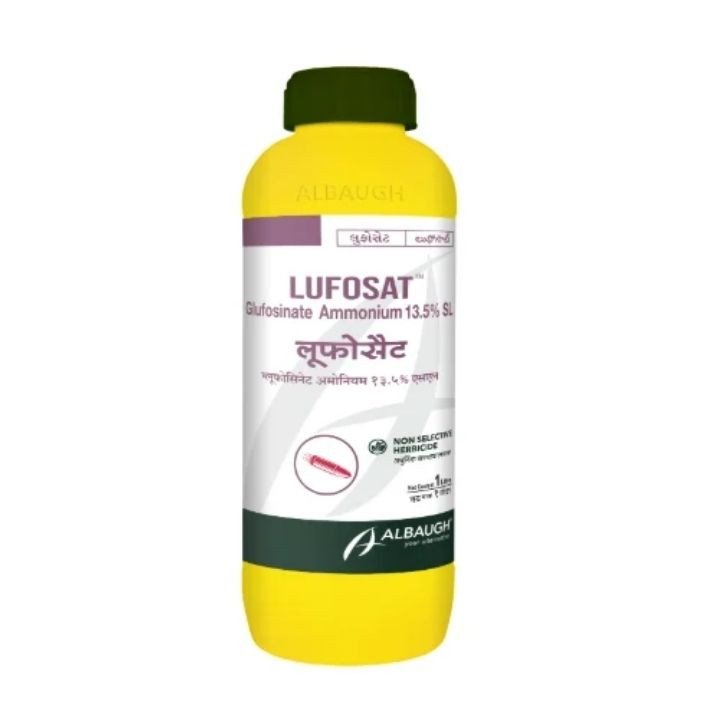
Albaugh Lufosat Herbicide (Glufosinate Ammonium 13.5% SL)
Broad-Spectrum Non-Selective Herbicide for Weed Management in Cotton and Tea
Albaugh Lufosat is a broad-spectrum non-selective herbicide containing Glufosinate Ammonium 13.5% SL. It is recommended for post-emergence management of important grassy and broadleaf weeds in cotton and tea when applied as a directed or hooded spray according to label instructions.
Lufosat provides rapid knockdown of actively growing susceptible weeds. It inhibits an important plant enzyme involved in nitrogen metabolism, resulting in ammonia accumulation, disruption of photosynthesis and progressive drying of treated weed tissues.
Product Specifications
| Product Name | Lufosat |
|---|---|
| Brand | Albaugh |
| Product Type | Non-Selective Herbicide |
| Technical Name | Glufosinate Ammonium 13.5% SL |
| Formulation | SL - Soluble Liquid |
| Application Type | Post-Emergence Directed / Hooded Spray |
| Mode of Action Group | Glutamine Synthetase Inhibitor - HRAC Group 10 |
| Recommended Crops | Cotton and Tea |
| Target Weed Spectrum | Grassy Weeds, Broadleaf Weeds and Certain Sedges |
Technical Composition
| Active Ingredient | Glufosinate Ammonium |
|---|---|
| Concentration | 13.5% SL |
| Formulation | Soluble Liquid (SL) |
| Herbicide Type | Broad-Spectrum Non-Selective Post-Emergence Herbicide |
Key Features of Albaugh Lufosat
- Broad-Spectrum Weed Control: Effective against a range of grassy and broadleaf weeds in label-recommended crops.
- Rapid Knockdown: Albaugh highlights faster visible knockdown compared with many systemic herbicides.
- Post-Emergence Action: Designed for application to actively growing emerged weeds.
- Non-Selective Herbicide: Controls susceptible green vegetation contacted by the spray.
- Useful on Difficult Weeds: Albaugh positions Lufosat as an option for weeds that may be poorly controlled by some glyphosate or paraquat programs.
- Directed Spray Use: Suitable for hooded or directed applications that help minimise contact with the crop.
- Cotton & Tea Registration: Official Albaugh information lists cotton and tea as the recommended crops.
Benefits of Lufosat Herbicide
- Helps manage mixed weed populations in cotton and tea.
- Controls important grassy weeds.
- Controls several important broadleaf weeds.
- Provides rapid visible weed knockdown.
- Helps reduce competition for nutrients, moisture, sunlight and growing space.
- Useful for inter-row and directed weed-management programs.
- Can provide an alternative mode of action in herbicide programs where appropriate.
Recommended Crops and Dosage
| Crop | Recommended Dose | Approx. Dose per Acre | Water Volume | Waiting Period |
|---|---|---|---|---|
| Cotton | 2.5–3.0 L/ha | Approx. 1.0–1.2 L/acre | 500 L/ha | 96 Days |
| Tea | 2.5–3.3 L/ha | Approx. 1.0–1.34 L/acre | 375–500 L/ha | 15 Days |
Use Lufosat only according to the current product label. Dose, spray volume, weed stage and crop-safety precautions should be followed carefully for each crop.
Target Weeds in Cotton
| Botanical Name | Weed Type |
|---|---|
| Echinochloa spp. | Grassy Weed |
| Cynodon dactylon | Perennial Grass |
| Cyperus rotundus | Sedge |
| Digitaria marginata | Grassy Weed |
| Dactyloctenium aegyptium | Grassy Weed |
Target Weeds in Tea
| Botanical Name | Weed Type |
|---|---|
| Panicum repens | Grassy Weed |
| Borreria hispida | Broadleaf Weed |
| Imperata cylindrica | Perennial Grass |
| Digitaria sanguinalis | Grassy Weed |
| Commelina benghalensis | Broadleaf Weed |
| Ageratum conyzoides | Broadleaf Weed |
| Eleusine indica | Grassy Weed |
| Paspalum conjugatum | Grassy Weed |
Mode of Action
Glufosinate Ammonium inhibits the enzyme glutamine synthetase in susceptible plants. This enzyme is essential for normal nitrogen metabolism.
After treatment, ammonia accumulates within susceptible weed tissues and normal photosynthetic processes are disrupted. Weed growth stops, followed by chlorosis, tissue damage and progressive drying of the treated vegetation.
Rapid Contact-Like Weed Knockdown
Lufosat acts mainly on green plant tissues contacted by the spray and produces relatively rapid visible symptoms. Thorough spray coverage of actively growing weeds is therefore important for effective control.
Compared with strongly systemic herbicides, movement within the weed is limited, so uniform coverage of the target vegetation is especially important.
Non-Selective Herbicidal Action
Lufosat is a non-selective herbicide. This means spray contacting green crop tissue can cause injury. Applications in cotton and tea should therefore be carefully directed toward weeds while protecting crop leaves, tender stems and other green crop parts.
A hooded or shielded sprayer can help reduce unintended spray contact with the crop.
Lufosat for Cotton Weed Management
In cotton, Lufosat is recommended for management of weeds including Echinochloa species, Cynodon dactylon, Cyperus rotundus, Digitaria marginata and Dactyloctenium aegyptium.
Use a directed or hooded inter-row spray and prevent the herbicide from contacting green cotton foliage or stems.
Lufosat for Tea Weed Management
In tea plantations, Lufosat provides broad-spectrum activity against important weeds such as Panicum repens, Borreria hispida, Imperata cylindrica, Digitaria sanguinalis, Commelina benghalensis, Ageratum conyzoides, Eleusine indica and Paspalum conjugatum.
The spray should be directed toward actively growing weeds while avoiding contact with green tea foliage and other desirable vegetation.
Best Weed Stage for Application
Apply Lufosat when target weeds are young and actively growing. Weeds that are drought-stressed, mature, dusty or otherwise under severe environmental stress may respond less consistently.
Good weed coverage and suitable growing conditions around the time of application help improve herbicide performance.
How to Use Albaugh Lufosat
- Identify the crop and target weeds before application.
- Confirm the crop-specific dose on the current Lufosat label.
- Use a directed or hooded spray arrangement where required.
- Partially fill the spray tank with clean water.
- Add the measured quantity of Lufosat while maintaining agitation.
- Add the remaining required water and mix thoroughly.
- Spray uniformly over actively growing weeds.
- Avoid spray contact with green crop foliage, stems and other desirable plants.
- Avoid excessive overlap between spray passes.
Application Tips
- Apply to actively growing emerged weeds.
- Ensure complete coverage of target foliage.
- Use a hood or shield around the spray nozzle where appropriate.
- Prevent contact with green crop tissues.
- Use properly calibrated spraying equipment.
- Avoid spraying during strong winds.
- Prevent spray drift onto neighbouring crops and desirable vegetation.
- Do not exceed the crop-specific recommended dose.
- Observe the label-specified waiting period before harvest.
Why Directed or Hooded Spraying Is Important
Because Lufosat is non-selective, it can injure desirable plants when spray droplets contact green tissues. A hooded or directed spray helps keep the herbicide concentrated on weeds growing between crop rows while reducing unintended crop exposure.
Careful application is particularly important in young crops and wherever crop foliage is close to the target weeds.
Weed Management and Herbicide Rotation
Glufosinate Ammonium has a different mode of action from herbicides such as glyphosate and paraquat. Using appropriate herbicide rotation together with cultural and mechanical weed-management practices can help diversify weed-control programs.
Do not rely repeatedly on a single herbicide mode of action. Follow local agronomic recommendations and the current product label when planning repeated weed-control treatments.
Important Safety Precautions
- Wear gloves, protective clothing and suitable eye protection during mixing and spraying.
- Avoid direct contact with skin and eyes.
- Avoid inhaling spray mist.
- Do not eat, drink or smoke while handling the herbicide.
- Wash hands and exposed skin thoroughly after application.
- Keep away from children, animals, food and animal feed.
- Avoid contamination of ponds, canals and other water sources.
- Prevent spray drift to neighbouring crops and non-target plants.
Why Farmers Can Choose Albaugh Lufosat
- Albaugh broad-spectrum non-selective herbicide.
- Contains Glufosinate Ammonium 13.5% SL.
- Recommended for cotton and tea.
- Controls grassy and broadleaf weeds.
- Also controls certain difficult sedges in cotton.
- Provides rapid visible weed knockdown.
- Suitable for directed and hooded spray applications.
- Provides an additional herbicide mode of action for weed-management programs.
Frequently Asked Questions
Q1. What is Albaugh Lufosat?
Albaugh Lufosat is a broad-spectrum non-selective herbicide containing Glufosinate Ammonium 13.5% SL.
Q2. Which crops is Lufosat recommended for?
Albaugh's current official product information lists cotton and tea.
Q3. What weeds does Lufosat control?
Lufosat controls several label-recommended grassy and broadleaf weeds and certain sedges in cotton and tea.
Q4. What is the Lufosat dose for cotton?
The registered rate is 2.5–3.0 litres per hectare, equivalent to approximately 1.0–1.2 litres per acre.
Q5. What is the Lufosat dose for tea?
The registered rate is 2.5–3.3 litres per hectare, equivalent to approximately 1.0–1.34 litres per acre.
Q6. How much water is required in cotton?
The registered recommendation is approximately 500 litres of water per hectare, equivalent to about 200 litres per acre.
Q7. How much water is required in tea?
The registered recommendation is approximately 375–500 litres per hectare, equivalent to roughly 150–200 litres per acre.
Q8. Is Lufosat selective?
No. Lufosat is a non-selective herbicide and can injure green crop tissue if directly sprayed on it.
Q9. Should Lufosat be sprayed directly over cotton or tea plants?
No. The spray should be directed toward target weeds while protecting green crop tissues. Hooded or shielded application is recommended where appropriate.
Q10. How does Glufosinate Ammonium work?
It inhibits glutamine synthetase, causing ammonia accumulation and disruption of photosynthesis in susceptible weeds, ultimately leading to weed death.
Q11. What is the waiting period for cotton?
The registered reference specifies a 96-day waiting period for cotton.
Q12. What is the waiting period for tea?
The registered reference specifies a 15-day waiting period for tea.
Q13. Can Lufosat control Cyperus rotundus?
Yes. Cyperus rotundus is included among the registered target weeds in cotton.
Q14. Can Lufosat be used on crops other than cotton and tea?
Do not use it on other crops unless they are specifically included on the current registered Lufosat label.
Albaugh Lufosat for Broad-Spectrum Weed Control in Cotton and Tea
Albaugh Lufosat Herbicide (Glufosinate Ammonium 13.5% SL) is a broad-spectrum non-selective post-emergence herbicide for management of important grassy, broadleaf and certain sedge weeds in cotton and tea. Proper directed application, complete weed coverage and protection of green crop tissues are important for effective and safe use.
Disclaimer: The details provided are for informational guidance only. Always adhere to the recommended application instructions as stated on the product label and in the accompanying leaflet.
Similar Products
Best Selling
Customer Reviews
Recent Reviews
No reviews yet.