

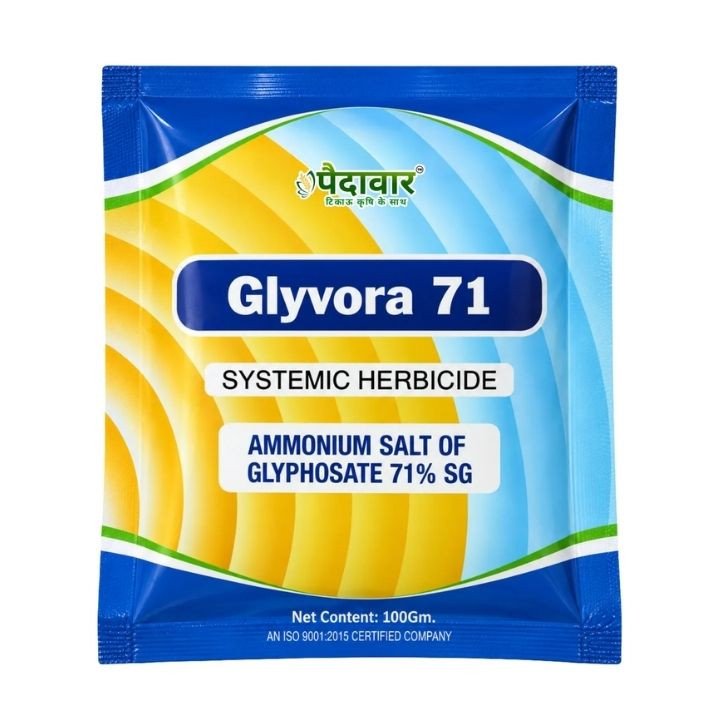
Paidavaar GLYVORA 71 Herbicide (Ammonium Salt of Glyphosate 71% SG)
Paidavaar GLYVORA 71 Herbicide – Ammonium Salt of Glyphosate 71% SG
Paidavaar GLYVORA 71 Herbicide contains Ammonium Salt of Glyphosate 71% SG, a systemic, non-selective and post-emergence herbicide used for controlling a broad spectrum of annual and perennial grassy and broadleaf weeds in tea and non-crop areas.
Glyphosate is absorbed mainly through actively growing foliage and translocated within the weed to growing points, roots and rhizomes. This systemic movement helps manage established and difficult perennial weeds when the product is applied at the recommended growth stage and according to the current product label.
Product Specifications
| Product Name | GLYVORA 71 |
| Brand | Paidavaar |
| Brand Company | Sarvin Agro Chemicals Private Limited |
| Product Type | Herbicide |
| Technical Name | Ammonium Salt of Glyphosate 71% SG |
| Formulation | Soluble Granules (SG) |
| Action | Systemic |
| Selectivity | Non-Selective |
| Application Timing | Post-Emergence |
| Registered Use Area for this Technical Composition | Tea and Non-Crop Areas |
| Application Method | Directed Foliar Spray |
Technical Composition
Ammonium Salt of Glyphosate 71% SG
Glyphosate is a broad-spectrum systemic herbicide. Because it is non-selective, spray contacting green leaves or other actively growing parts of desirable plants can cause serious injury. Application should therefore be carefully directed only towards the weeds intended for treatment.
Key Features
- High-concentration Ammonium Salt of Glyphosate 71% SG formulation.
- Systemic herbicide absorbed through actively growing weed foliage.
- Non-selective action against a broad range of grassy and broadleaf weeds.
- Suitable for post-emergence weed management.
- Translocates from treated foliage towards growing points, roots and rhizomes.
- Useful for management of established annual and perennial weeds.
- Registered-use pattern for this technical composition covers tea and non-crop areas.
Benefits of Paidavaar GLYVORA 71
- Systemic Weed Management: The active ingredient moves within treated weeds rather than acting only on the sprayed leaf surface.
- Broad-Spectrum Activity: Useful against several grassy, broadleaf and perennial weed species.
- Root & Rhizome Activity: Translocation helps the active ingredient reach underground growing parts of susceptible weeds.
- Post-Emergence Use: Applied after weeds have emerged and developed sufficient foliage for herbicide absorption.
- Useful Against Difficult Weeds: The registered technical formulation includes several persistent perennial weeds among its target species.
Recommended Use & Target Weeds
Registered-use information for Ammonium Salt of Glyphosate 71% SG recommends the formulation for tea and non-crop areas against weeds including:
- Acalypha indica
- Ageratum conyzoides
- Cichorium intybus
- Digera arvensis
- Digitaria sanguinalis
- Paspalum conjugatum
- Sida acuta
- Ipomoea digitata
- Cynodon dactylon
- Cyperus rotundus
- Eragrostis spp.
Use GLYVORA 71 only for crops, areas and weeds permitted on its current physical product label. Do not extrapolate glyphosate recommendations to standing crops that are not specifically approved.
Dosage and Application
| Use Area | Technical-Registration Reference Dose | Water Volume |
|---|---|---|
| Tea & Non-Crop Areas | 3 kg formulation per hectare | 500 litres per hectare |
| Approximate Acre Equivalent | About 1.2 kg per acre | About 200 litres per acre |
| Approximate Concentration | About 6 g per litre of water | As required for uniform weed coverage |
The above rate is based on registered-use information for the technical formulation Ammonium Salt of Glyphosate 71% SG. The current GLYVORA 71 product label should always be treated as the final authority for dose and application instructions.
Mode of Action
Glyphosate is a systemic EPSPS-inhibiting herbicide. It inhibits the enzyme 5-enolpyruvylshikimate-3-phosphate synthase (EPSPS), which is involved in the shikimate pathway responsible for production of essential aromatic amino acids in plants.
After absorption through green foliage, glyphosate is translocated to actively growing tissues, including shoots, roots and rhizomes. Disruption of essential plant metabolic processes gradually stops weed growth and leads to the decline of susceptible plants.
Best Time to Apply
For perennial weeds, registered label guidance recommends post-emergence treatment when weeds have sufficient actively growing foliage. Perennial weeds are generally recommended to have approximately 4–8 leaves so adequate herbicide absorption and translocation can take place.
Avoid spraying during rainfall, strong winds or very hot sunny conditions. Do not spray weeds that are severely stressed or where adequate leaf coverage cannot be obtained.
How to Use Paidavaar GLYVORA 71
- Identify the target weeds and confirm that the intended use is permitted on the current product label.
- Measure the recommended quantity accurately.
- Dissolve the granules in the required quantity of clean water.
- Mix thoroughly until a uniform spray solution is obtained.
- Apply directly and uniformly to actively growing weed foliage.
- Use a suitable sprayer fitted with an appropriate flat-fan or flood-jet type nozzle where recommended.
- Avoid spray contact with leaves, green stems or other actively growing parts of desirable plants.
Application Tips
- Apply only to actively growing weeds with sufficient leaf area.
- Ensure uniform wetting of weed foliage without excessive runoff.
- Do not allow spray drift onto desirable crops or vegetation.
- Because the herbicide is non-selective, even accidental contact may damage nearby plants.
- Avoid application during rainy or windy weather.
- Use clean water for preparing the spray solution.
- Do not exceed the dose specified on the current product label.
- Follow state-specific regulations governing sale and use of glyphosate products.
Safety Precautions
- Read the complete product label and leaflet before handling or application.
- Wear suitable gloves, protective clothing, eye protection and other recommended PPE during mixing and spraying.
- Avoid contact with skin, eyes and mouth.
- Avoid inhaling spray mist.
- Do not eat, drink or smoke while handling the herbicide.
- Avoid contamination of ponds, streams, irrigation water and aquaculture areas.
- Keep children and animals away from the treatment area according to label instructions.
- Wash hands, exposed skin and spray equipment thoroughly after use.
- Store securely in the original container away from food, feed and children.
Why Farmers Can Choose Paidavaar GLYVORA 71
Paidavaar GLYVORA 71 provides the concentrated systemic herbicide technical Ammonium Salt of Glyphosate 71% SG for management of difficult annual and perennial weeds. Its systemic translocation and non-selective activity make it useful for directed post-emergence weed management in permitted tea and non-crop uses when applied strictly according to label directions.
Frequently Asked Questions
Q1. What is Paidavaar GLYVORA 71?
Paidavaar GLYVORA 71 is a systemic, non-selective post-emergence herbicide containing Ammonium Salt of Glyphosate 71% SG.
Q2. What is the technical composition of GLYVORA 71?
The supplied technical composition is Ammonium Salt of Glyphosate 71% SG.
Q3. Is GLYVORA 71 selective or non-selective?
It is a non-selective herbicide. Spray should not contact green leaves or actively growing parts of desirable crops or plants.
Q4. Is GLYVORA 71 a systemic herbicide?
Yes. Glyphosate is absorbed through weed foliage and translocated to growing points, roots and rhizomes.
Q5. Where is Ammonium Salt of Glyphosate 71% SG registered for use?
The registered-use information verified for this technical formulation covers tea and non-crop areas. Always confirm the permitted use on the current GLYVORA 71 label before spraying.
Q6. What is the dose of Glyphosate 71% SG?
Registered-use information for Ammonium Salt of Glyphosate 71% SG specifies 3 kg formulation per hectare in 500 litres of water, approximately 1.2 kg per acre in about 200 litres of water. The current GLYVORA 71 label should be followed as the final dose instruction.
Q7. How much Glyphosate 71% SG is used per litre of water?
The registered hectare dose and water volume correspond to approximately 6 g per litre of water. Actual application must follow the current product label and approved use pattern.
Q8. When should perennial weeds be sprayed?
Registered label guidance recommends treating perennial weeds after emergence when they have sufficient active foliage, generally around 4–8 leaves, to support effective absorption and translocation.
Q9. Can GLYVORA 71 be sprayed directly over standing crops?
No general over-the-crop recommendation should be assumed. Glyphosate is non-selective and can damage desirable vegetation. Use only in the manner and areas specifically permitted on the current product label.
Q10. Can GLYVORA 71 be used in any non-crop area?
Use should comply with the current product label as well as applicable central and state regulations. Avoid use near water bodies or in any location where the label or local regulations prohibit application.
Paidavaar GLYVORA 71 Glyphosate Herbicide for Post-Emergence Weed Management
Paidavaar GLYVORA 71 Herbicide with Ammonium Salt of Glyphosate 71% SG is a systemic, non-selective post-emergence herbicide intended for management of susceptible annual and perennial weeds in permitted tea and non-crop uses. Proper directed application, adequate actively growing foliage and strict avoidance of desirable vegetation are important for responsible use.
Disclaimer: The details provided are for informational guidance only. Always adhere to the recommended application instructions as stated on the product label and in the accompanying leaflet.
Similar Products


Best Selling
Customer Reviews
Recent Reviews
No reviews yet.