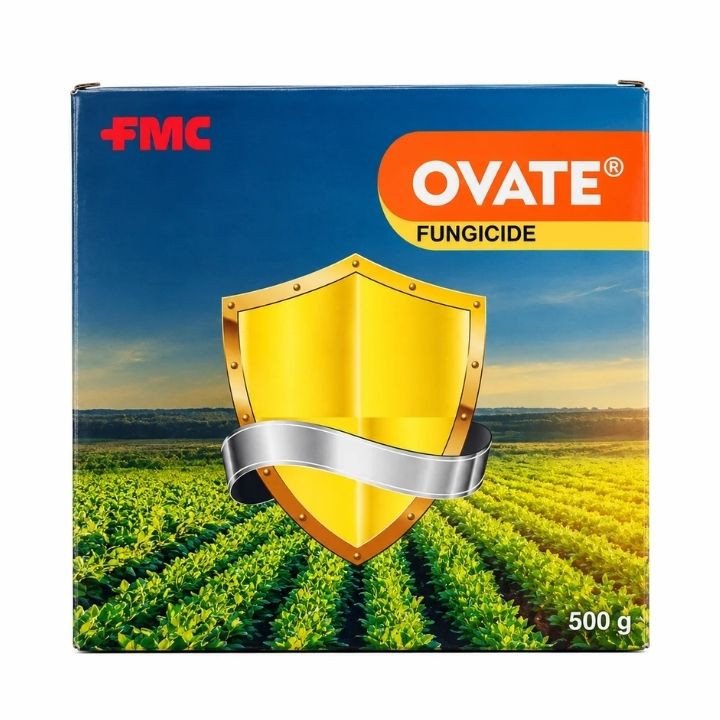

FMC Ovate Fungicide is a broad-spectrum contact fungicide containing Chlorothalonil 75% WP. It provides multi-site fungicidal activity and is designed to protect crops against several important fungal diseases affecting leaves, fruits and other plant surfaces.
Ovate acts primarily as a protective contact fungicide. Chlorothalonil remains on treated plant surfaces and acts at multiple sites in susceptible fungal cells, helping inhibit spore germination and disease establishment. Its multi-site mode of action also makes it useful as part of a responsible fungicide resistance-management programme.
| Product Name | Ovate |
| Brand | FMC |
| Company | FMC India Private Limited |
| Product Type | Fungicide |
| Technical Name | Chlorothalonil 75% WP |
| Formulation | Wettable Powder (WP) |
| Fungicide Type | Broad-Spectrum Contact Fungicide |
| Mode of Action | Multi-Site Contact Action |
| FRAC Group | M05 |
| Application Method | Foliar Spray |
Chlorothalonil 75% WP
Chlorothalonil is a non-systemic, multi-site contact fungicide belonging to FRAC Group M05. It acts on several biochemical processes in fungal cells and helps inhibit spore germination and fungal development on treated plant surfaces.
| Crop | Target Disease |
|---|---|
| Groundnut | Tikka Leaf Spot and Rust |
| Potato | Early Blight and Late Blight |
| Grapes | Anthracnose and Downy Mildew |
| Apple | Scab |
| Chilli | Fruit Rot |
| Watermelon | Downy Mildew and Leaf Spot |
| Crop | Recommended Formulation Dose | Water Requirement | Waiting Period |
|---|---|---|---|
| Groundnut | Approximately 880–1150 g/ha | 600–800 L/ha | 14 Days |
| Potato | Approximately 875–1250 g/ha | 600–800 L/ha | 14 Days |
| Grapes | Approximately 200 g per 100 L water | According to crop canopy and label direction | 60 Days |
| Apple | Approximately 200 g per 100 L water | According to tree size and label direction | 45 Days |
| Chilli | Approximately 800 g/ha | Approximately 750 L/ha | 10 Days |
| Watermelon | Approximately 2 g per litre of water | Approximately 500 L/ha | 3 Days |
| Groundnut | Approximately 355–465 g per acre |
| Potato | Approximately 350–505 g per acre |
| Chilli | Approximately 320–325 g per acre |
The acre rates are approximate conversions from the registered hectare recommendations. For crops where the recommendation is expressed as concentration per volume of water, maintain the label concentration rather than converting it into a general per-acre rate.
Chlorothalonil – FRAC Group M05: Chlorothalonil is a multi-site contact fungicide. It interacts with multiple fungal enzymes and cellular processes, interfering with normal energy production and fungal development.
Because Chlorothalonil acts at multiple biochemical sites, it provides broad protective activity and can play an important role in fungicide resistance-management programmes.
In groundnut, Chlorothalonil 75% WP is used for management of tikka leaf spot and rust. These diseases can damage crop foliage and reduce the amount of healthy leaf area available for crop growth.
The registered formulation rate is approximately 880–1150 g per hectare with adequate spray-water volume for thorough crop coverage.
Ovate is useful in potato for management of early blight and late blight. Timely protective application is particularly important because blight diseases can spread rapidly under favourable weather conditions.
The registered formulation rate is approximately 875–1250 g per hectare, depending on the label recommendation and disease-management programme.
FMC lists Ovate for management of anthracnose and downy mildew in grapes. The registered Chlorothalonil 75% WP concentration is approximately 200 g per 100 litres of water.
Thorough canopy coverage is important because Chlorothalonil acts primarily on the treated plant surface.
In apple, Chlorothalonil 75% WP is recommended for management of scab. Apply according to the current label concentration and tree-specific spray-water requirement.
In chilli, the Chlorothalonil 75% WP recommendation includes fruit rot. Timely spray application and good crop coverage are important for disease-management performance.
FMC lists Ovate for downy mildew and leaf spot in watermelon. Registered technical recommendations use approximately 2 g per litre of water for this use.
Ovate works best when sufficient fungicide is present on susceptible crop surfaces before or during the early development of fungal disease. As a contact fungicide, good spray coverage is particularly important.
Do not depend on the product to restore tissue that has already been severely damaged by disease. Begin the disease-management programme at an appropriate stage according to the current label and local disease pressure.
Apply Ovate preventively or during the early appearance of the registered fungal disease according to the product label. Contact fungicides generally provide better protection when they are present on the plant surface before heavy disease establishment.
Application should preferably be carried out under suitable weather conditions when strong winds and immediate rainfall are not expected.
Chlorothalonil belongs to FRAC Group M05 and has multi-site contact activity. Multi-site fungicides are useful in resistance-management programmes because susceptible fungi must overcome activity at multiple biochemical sites.
For sustainable disease management, integrate Ovate with crop sanitation, resistant varieties where available, appropriate irrigation practices and fungicides with other suitable modes of action.
FMC Ovate Fungicide combines broad-spectrum disease protection with the multi-site contact action of Chlorothalonil 75% WP. It helps manage important diseases including tikka leaf spot, rust, early and late blight, anthracnose, downy mildew, apple scab, chilli fruit rot and watermelon leaf spot when used according to crop-specific recommendations.
Ovate is an FMC broad-spectrum contact fungicide containing Chlorothalonil 75% WP.
It contains Chlorothalonil 75% WP.
Ovate is primarily a non-systemic contact fungicide with multi-site activity.
Chlorothalonil belongs to FRAC Group M05, a multi-site contact fungicide group.
Chlorothalonil 75% WP is recommended for tikka leaf spot and rust in groundnut.
It is recommended for management of early blight and late blight in potato.
Yes. FMC lists Ovate for management of anthracnose and downy mildew in grapes.
Yes. FMC's current product information lists scab in apple among the recommended uses.
FMC lists fruit rot as the target disease for chilli.
Yes. FMC lists downy mildew and leaf spot in watermelon among its target diseases.
The registered Chlorothalonil 75% WP recommendation specifies approximately 14 days between the last application and harvest for groundnut and potato.
Apply preventively or during the early stage of disease development according to the current product label and local disease conditions.
FMC Ovate Fungicide with Chlorothalonil 75% WP helps manage tikka leaf spot, rust, early and late blight, anthracnose, downy mildew, scab, fruit rot and leaf spot in recommended crops. Its multi-site contact action provides broad protective disease management when applied with thorough crop coverage and according to label directions.
Disclaimer: The details provided are for informational guidance only. Always adhere to the recommended application instructions as stated on the product label and in the accompanying leaflet.
No reviews yet.