

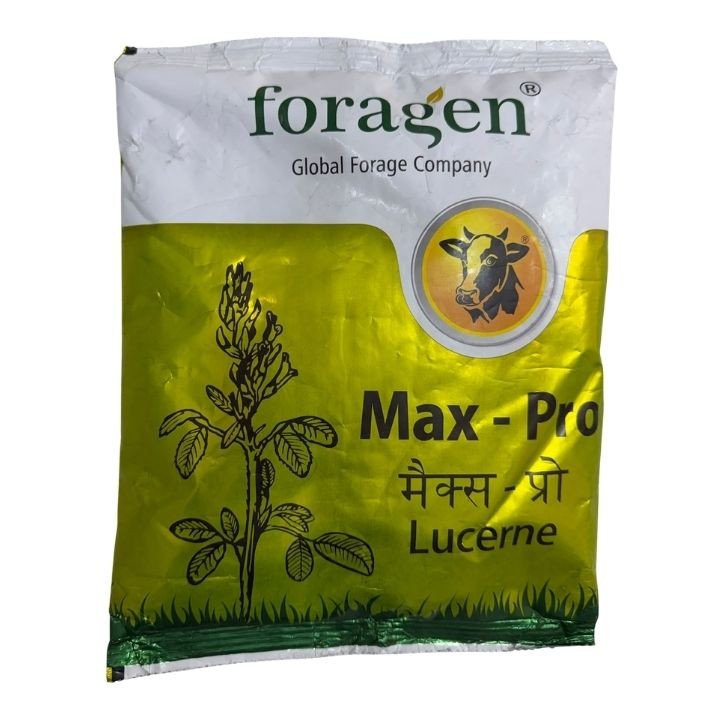


Foragen Max-Pro Lucerne Fodder Seeds – Perennial Multi-Cut Alfalfa
Foragen Max-Pro Lucerne Fodder Seeds – Perennial Multi-Cut Alfalfa
Foragen Max-Pro Lucerne Fodder Seeds are perennial fodder seeds developed for growing nutritious, protein-rich green fodder for dairy animals. Lucerne, also known as alfalfa or Medicago sativa, is a deep-rooted leguminous forage crop that supports repeated harvesting after establishment. The manufacturer promotes Max-Pro for high fodder yield, palatability and digestible protein, with a potential of up to 30 cuts over its productive life under suitable management. It is an option for farmers looking to establish a long-term green fodder supply for cattle and other livestock.
Product Details
| Brand | Foragen |
|---|---|
| Company | Foragen Seeds Private Limited |
| Product Name | Max-Pro |
| Crop | Lucerne / Alfalfa |
| Botanical Name | Medicago sativa |
| Product Type | Fodder Seeds |
| Crop Duration | Perennial |
| Harvesting Type | Multi-Cut |
| Potential Cuts | Up to 30 cuts, as claimed by the manufacturer; not guaranteed |
| Main Use | Green Fodder and Hay Production |
| Suitable Soil | Fertile, well-drained soil |
| Sowing Method | Line Sowing or Broadcasting |
Key Features and Benefits
- Perennial Fodder: Lucerne is a long-duration crop that can provide repeated fodder harvests after establishment.
- Multi-Cut Potential: Foragen markets Max-Pro with the potential for up to 30 cuts over its productive life under favourable conditions.
- Protein-Rich Forage: Lucerne is valued for its protein content and contribution to balanced livestock feeding.
- Palatable Fodder: The manufacturer highlights digestibility and palatability as key product features.
- Deep Root System: Established lucerne has relatively deep roots and can tolerate periods of limited moisture better than some shallow-rooted fodder crops.
- Root-Rot Tolerance: The manufacturer claims tolerance to root rot; proper field drainage remains essential.
- Hay Production: Lucerne can be harvested for fresh green fodder or dried and preserved as hay.
- Leguminous Crop: With effective Rhizobium nodulation, lucerne can fix atmospheric nitrogen.
Suitable For
- Dairy cattle fodder production
- Buffalo feeding programmes
- Green fodder cultivation for livestock farms
- Protein-rich fodder production
- Multi-cut fodder farming
- Hay making and fodder conservation
Introduce lucerne gradually as part of a balanced livestock ration. Avoid suddenly feeding large quantities of lush lucerne to hungry ruminants because legume-rich fodder may increase the risk of bloat.
Sowing Time and Growing Conditions
Lucerne is commonly established during the cooler sowing season. In many northern Indian regions, October to November is a suitable period, while sowing schedules differ in other agro-climatic zones. Follow local agricultural recommendations for the best planting window.
Select a fertile, well-drained field with adequate irrigation access. Lucerne does not tolerate prolonged waterlogging. A fine, firm seedbed helps the small seeds establish evenly.
Seed Rate and Sowing Method
| Parameter | General Lucerne Cultivation Guidance |
|---|---|
| Indicative Seed Rate | Approximately 6–10 kg per acre, depending on sowing method and local recommendation |
| Row Spacing | Approximately 25 cm |
| Sowing Depth | Approximately 1–1.5 cm |
| Sowing Method | Line sowing or broadcasting in a prepared seedbed |
| Soil Condition | Fine, firm, fertile and well-drained |
| Seed Inoculation | Use suitable lucerne-specific Rhizobium inoculant when recommended |
Important: These are general agricultural recommendations for lucerne, not a verified Max-Pro-specific seed rate. The exact rate may vary by region, seed quality, field conditions and planting method. Follow the original seed packet and local agricultural advice.
How to Sow Max-Pro Lucerne Seeds
- Choose a fertile field with good drainage and adequate irrigation facilities.
- Prepare a fine, firm seedbed by ploughing and levelling the soil.
- Apply suitable manure and fertilizers according to soil-test results.
- Use an appropriate Rhizobium inoculant if required and compatible with the seed treatment.
- Sow the seeds shallowly using line sowing or broadcasting.
- Cover lightly with soil and provide gentle irrigation to support germination.
- Control weeds during early establishment and avoid water stagnation.
Irrigation and Crop Management
Maintain adequate moisture during germination and early growth. Established lucerne can access moisture from deeper soil layers, but irrigation is still important for productive fodder harvesting. Irrigation frequency depends on soil type, temperature, rainfall and crop growth.
Maintain soil fertility, especially phosphorus, potassium and other nutrients indicated by soil testing. Prevent prolonged waterlogging and monitor the crop for weeds, pests and diseases.
Fodder Harvesting and Cutting
Allow the crop to establish properly before the first cut. Subsequent harvesting should be planned according to crop regrowth, seasonal conditions and local recommendations. General lucerne guidance commonly places subsequent cuts around 30–40 days apart under suitable growing conditions, but the interval is not fixed for every field.
Foragen promotes Max-Pro with a potential of up to 30 cuts over its productive life. The actual number depends on crop persistence, irrigation, nutrition, cutting height, season and field management. This should not be interpreted as 30 cuts per year.
Frequently Asked Questions
1. What is Foragen Max-Pro?
Max-Pro is a perennial lucerne or alfalfa fodder seed product marketed by Foragen for multi-cut, protein-rich fodder cultivation.
2. Is Max-Pro a multi-cut fodder variety?
Yes. It is a perennial multi-cut lucerne product. The manufacturer advertises the potential for up to 30 cuts under suitable conditions.
3. What is the seed rate per acre?
General lucerne cultivation guidance suggests approximately 6–10 kg per acre, depending on local conditions and sowing method. Confirm the exact Max-Pro rate from the original packet.
4. What is the best sowing time?
October to November is commonly suitable in many northern Indian regions. Other regions may have different recommended sowing windows.
5. Can Max-Pro be used for dairy cattle fodder?
Yes. Lucerne is a protein-rich fodder crop commonly used in dairy livestock feeding as part of a balanced ration.
6. Does Max-Pro produce 30 cuts in one year?
No such annual claim is verified. The manufacturer states up to 30 cuts, which should be understood as potential over the crop's productive life rather than a guaranteed yearly harvest.
7. Can lucerne be grown in waterlogged soil?
No. Lucerne performs best in well-drained soil, and prolonged waterlogging can damage roots and reduce crop survival.
Disclaimer: Sowing rate, sowing time, harvesting frequency, fodder yield and crop longevity vary with local climate, soil, irrigation and management. The manufacturer's multi-cut and tolerance statements are product claims, not guaranteed field results. Follow the original seed packet and local agricultural recommendations.
Similar Products




Best Selling


Customer Reviews
Recent Reviews
No reviews yet.