

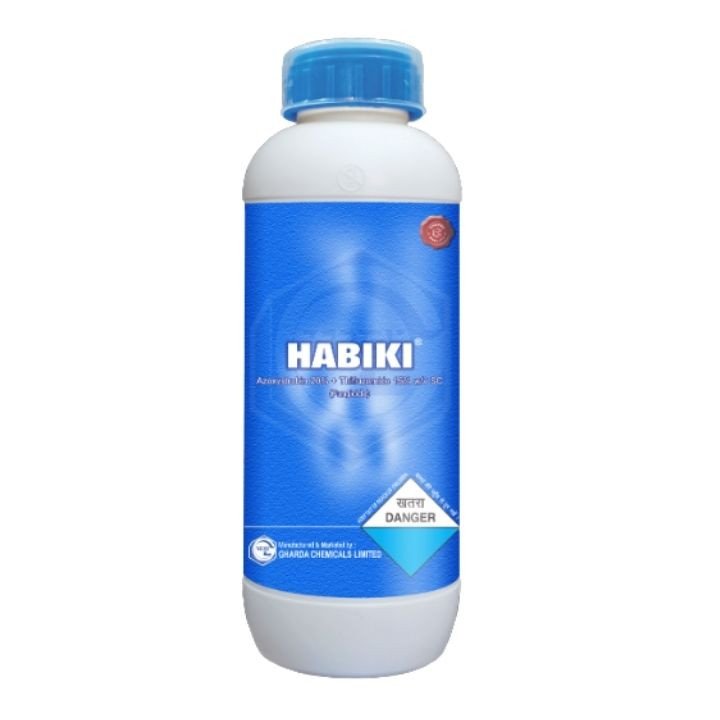
Gharda Habiki Fungicide
Gharda Habiki: One Spray, Two Major Paddy Diseases Covered
Sheath blight and leaf blast rarely announce themselves one at a time — in a humid paddy field, it's common to see both pressures building in the same season, sometimes in the same field within weeks of each other. Rather than reaching for two separate fungicides, Gharda Habiki combines Azoxystrobin 20% and Thifluzamide 15% in a single SC formulation, built specifically around this exact combination of paddy diseases.
The pairing works because the two actives don't compete for the same job. Azoxystrobin, a strobilurin, is well established for its broad activity against a wide range of fungal pathogens by interfering with fungal respiration. Thifluzamide brings more targeted strength specifically against Rhizoctonia solani, the pathogen behind sheath blight — so between the two, Habiki addresses both the broader blast pressure and the more specific sheath blight threat in one application.
Composition Snapshot
| Detail | Specification |
|---|---|
| Brand | Gharda |
| Product Name | Habiki |
| Active Ingredients | Azoxystrobin 20% + Thifluzamide 15% |
| Formulation | Suspension Concentrate (SC), w/v basis |
| Registered Crop | Rice (Paddy) |
The Two Diseases This Product Was Built Around
Sheath blight tends to show up during the tillering-to-booting window, spreading fastest under warm, humid conditions with dense canopy cover — exactly the environment most irrigated paddy fields create for themselves. Leaf blast, by contrast, can appear earlier in the vegetative stage and, left unmanaged, moves into the more damaging neck blast phase at heading. Habiki's registration specifically covers both.
| Crop | Disease |
|---|---|
| Rice | Sheath Blight |
| Rice | Leaf Blast |
Application Rate
Per the product's label recommendation, Habiki is applied at 100–120 gm of combined active ingredient per hectare, translating to roughly 375–450 ml of formulation, diluted in 500–600 litres of water. A pre-harvest interval of 28 days applies, meaning the last spray should be timed with the harvest calendar in mind rather than added as a late-season afterthought. A 24-hour re-entry period is also specified before workers should return to the treated field.
| Crop | Target Diseases | Dose (per Hectare) | Water Dilution | Pre-Harvest Interval | Re-Entry Period |
|---|---|---|---|---|---|
| Rice | Sheath Blight, Leaf Blast | 375–450 ml (100–120 gm a.i.) | 500–600 litres | 28 days | 24 hours |
The 28-day pre-harvest interval is longer than what many single-active fungicides carry, so it's worth planning the spray schedule with harvest date in mind from the outset, rather than treating this as a late-stage rescue option.
Applying It Well
Apply as a foliar spray with adequate water volume for even canopy coverage — paddy's dense growth habit at tillering and booting stages makes thorough spray penetration genuinely important, since patchy coverage tends to leave pockets where sheath blight can continue developing untreated. Spraying at the first appearance of either disease, rather than after lesions have spread extensively, generally gives the combination its best chance to perform.
Common Questions
Can Habiki be used if only one of the two diseases (say, just leaf blast) is present?
Yes — while it's formulated to cover both, using it against a single disease is fine; the dual-active combination doesn't require both pathogens to be present simultaneously.
Why does the pre-harvest interval run as long as 28 days?
This reflects the residue clearance profile for the combined active ingredients and should be strictly followed in planning the last spray relative to expected harvest timing.
Is thorough water coverage really that important for a systemic-acting product?
Yes — even with some systemic movement, initial spray coverage across the canopy directly affects how much of the crop actually receives protection, particularly for sheath blight developing low in the canopy.
How soon after spraying is it safe to re-enter the treated field?
A 24-hour re-entry period applies before workers should return to the treated area.
Disclaimer: The details provided are for informational guidance only. Always adhere to the recommended application instructions as stated on the product label and in the accompanying leaflet.
Frequently Asked Questions about Gharda Habiki Fungicide
What is the price of Gharda Habiki Fungicide?
The price of Gharda Habiki Fungicide starts at Rs. 1,224 (250 ml) at KisanShop. Final price depends on the pack size you choose.
Which pack sizes of Gharda Habiki Fungicide are available?
250 ml, 250 ml x 2, 250 ml x 4. Select the size you need on the product page.
Which brand makes Gharda Habiki Fungicide?
Gharda Habiki Fungicide is a product of GHARDA CHEMICALS LIMITED, available to buy online at KisanShop.
What payment options are available?
You can pay with UPI, debit or credit cards, or Cash on Delivery (COD, subject to availability for your pincode).
Can I return Gharda Habiki Fungicide?
Yes. KisanShop offers a 48 hours easy return. If you receive a wrong, damaged or defective product, we will replace it.
How long does delivery take?
KisanShop offers fast and reliable delivery. Exact delivery time depends on your pincode.
Similar Products
Best Selling
Customer Reviews
Recent Reviews
No reviews yet.