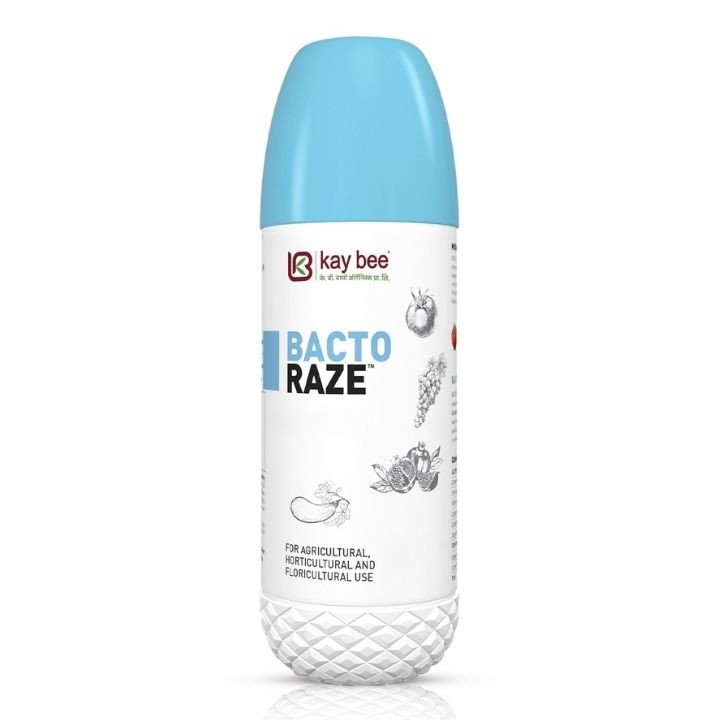
Bacterial diseases in plants respond very differently to treatment than fungal infections do — most conventional fungicides simply don't touch bacterial pathogens like Xanthomonas, Erwinia, Pseudomonas, Ralstonia, or Clavibacter, leaving growers with a narrower toolkit for managing conditions like bacterial blight, canker, or wilt. Kay Bee's Bacto Raze is built specifically to fill that gap, using botanical-based marker compound technology to target the structural integrity of the bacterial cell itself.
Its approach centers on disrupting the bacterial cell wall through two connected mechanisms — restricting the biosynthesis of lipid and protein components the bacteria need to build and maintain their cell wall, while simultaneously causing desiccation and lysis that leads to leakage of internal cellular material. Between the two, the bacterial cell essentially loses both its ability to grow new wall structure and the structural integrity of what it already has.
| Detail | Specification |
|---|---|
| Brand | Kay Bee Bio-Organics |
| Product Name | Bacto Raze |
| Category | Organic Bactericide (Bio-Pesticide) |
| Mode of Action | Contact and Systemic |
| Residue Profile | Residue-free, suitable for organic and export production |
| Pack Sizes | 100 ml, 250 ml, 500 ml, 1 litre, 5 litres |
Rather than being formulated around a single named disease, Bacto Raze is positioned against a genus-level range of plant pathogenic bacteria — Xanthomonas, Erwinia, Pseudomonas, Ralstonia, and Clavibacter among others. This matters because these genera are collectively responsible for most of the significant bacterial diseases across Indian agriculture, from blight and canker to wilt and rot, spanning agronomic crops, vegetables, fruits, and flowers.
Bacto Raze's preventive function works by stopping pathogen establishment before disease symptoms even develop — useful as a scheduled protective spray during periods of known disease risk. Its curative strength is specifically called out against two particularly troublesome conditions: oily spot in pomegranate and bacterial wilt in tomato, both diseases that can spread rapidly once established and are notoriously difficult to reverse with many conventional treatment options.
| Crop | Disease | Application Method | Dose |
|---|---|---|---|
| Pomegranate | Oily Spot | Spraying | 1.5–2.5 ml/litre |
| Paddy | Bacterial Blight | Spraying | 1.5–2.5 ml/litre |
| Tomato | Stem & Fruit Canker, Bacterial Leaf Spot | Spraying | 1.5–2.5 ml/litre |
| Tomato | Bacterial Wilt | Drenching / Soil Application | 500–1000 ml/acre |
| Mango | Bacterial Canker, Bacterial Fruit Rot | Spraying | 1.5–2.5 ml/litre |
| Chilli | Bacterial Leaf Spot | Spraying | 1.5–2.5 ml/litre or 500–1000 ml/acre |
| Chilli | Bacterial Wilt | Drenching | 500–1000 ml/acre |
| Potato | Bacterial Wilt | Drenching | 500–1000 ml/acre |
| Cotton | Angular Leaf Spot / Black Arm | Spraying | 1.5–2.5 ml/litre |
| Onion | Bulb Rot | Drenching | 500–1000 ml/acre |
| Citrus | Citrus Canker | Spraying | 1.5–2.5 ml/litre |
| Grape | Bacterial Blight, Leaf Spot | Spraying | 1.5–2.5 ml/litre |
Notice how tomato, chilli, and potato all show drenching or soil application for wilt-type diseases, while most other conditions on this list use foliar spraying. This split reflects where the pathogen is actually active — wilt diseases typically originate in the root zone and vascular system, so soil drenching delivers the bactericide directly where the infection is taking hold, while foliar diseases like leaf spot or canker respond better to direct spray contact on affected tissue.
Alongside its bactericidal action, Bacto Raze carries a phytotonic effect that's associated with enhanced crop productivity — a benefit reported independently of direct disease suppression. Its residue-free botanical formulation also makes it a suitable fit for both organic-certified production and conventional farming operations targeting export markets with strict residue limits.
How to control bacterial blight in pomegranate?
Spraying Bacto Raze at the recommended 1.5–2.5 ml/litre rate is effective for controlling bacterial blight in pomegranate, working through its dual contact and systemic action on the bacterial cell wall.
Which spray controls oily spot disease in pomegranate?
Bacto Raze is specifically noted for strong curative effect against oily spot in pomegranate, one of the two named diseases where its curative activity is specifically documented.
Which bactericide works for bacterial blight in cotton, paddy, and mango?
Bacto Raze's broad-spectrum formulation covers bacterial diseases across all three — angular leaf spot in cotton, bacterial blight in paddy, and bacterial canker in mango — each at the standard 1.5–2.5 ml/litre spray rate.
Why does tomato bacterial wilt need drenching instead of spraying?
Bacterial wilt develops in the plant's root and vascular system rather than on leaf surfaces, so drenching around the root zone delivers the bactericide directly to where the infection is established.
Disclaimer: The details provided are for informational guidance only. Always adhere to the recommended application instructions as stated on the product label and in the accompanying leaflet.
No reviews yet.