

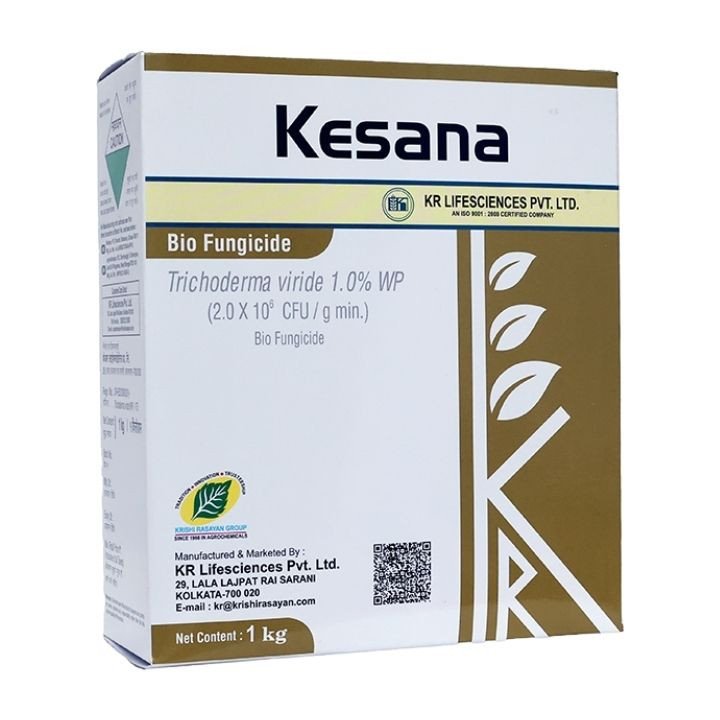
Krishi Rasayan Kesana Bio Fungicide (Trichoderma viride 1% WP)
Krishi Rasayan Kesana Bio Fungicide (Trichoderma viride 1% WP)
Krishi Rasayan Kesana Bio Fungicide is a microbial crop-protection product containing Trichoderma viride 1% WP. It is designed for biological suppression of fungal pathogens, with Krishi Rasayan specifically listing Fusarium oxysporum as a target.
Kesana works through several biological mechanisms including antibiosis, mycoparasitism, competition in the rhizosphere and priming of the crop's natural defence mechanisms. It is suitable for integration into soil-health and biological disease-management programmes.
Product Specifications
| Product Name | Kesana |
| Brand | Krishi Rasayan |
| Company | KR Lifesciences Private Limited |
| KisanShop Category | Bio Pesticide |
| Product Type | Microbial Bio Fungicide |
| Technical Composition | Trichoderma viride 1% WP |
| Formulation | Wettable Powder (WP) |
| Target Pathogen | Fusarium oxysporum |
| Recommended Crops | Chilli and Tomato |
| Primary Application | Soil Application |
Technical Composition
Trichoderma viride 1% WP
Trichoderma viride is a beneficial fungus used as a biological agent against susceptible fungal plant pathogens. It colonizes the crop root-zone environment and competes with disease-causing fungi while also acting directly against certain pathogens.
Key Features
- Microbial bio fungicide containing Trichoderma viride 1% WP.
- Designed for biological suppression of fungal pathogens.
- Krishi Rasayan specifically lists Fusarium oxysporum as a target.
- Works through antibiosis and mycoparasitism.
- Competes with harmful fungi within the rhizosphere.
- Helps prime the crop's natural defence mechanisms.
- Suitable for soil treatment.
- Can also be used for seed treatment according to current label directions.
- Suitable for integration into biological and integrated disease-management programmes.
Benefits of Krishi Rasayan Kesana
- Fungal Disease Suppression: Helps suppress susceptible soil-borne fungal pathogens.
- Fusarium Management: Fusarium oxysporum is specifically listed as a target by Krishi Rasayan.
- Mycoparasitic Activity: Trichoderma can directly interact with and suppress susceptible pathogenic fungi.
- Rhizosphere Competition: Beneficial Trichoderma competes with pathogens for space and available resources around the roots.
- Antibiosis: Biological metabolites contribute to suppression of competing fungal pathogens.
- Plant Defence Support: Helps prime crop self-defence mechanisms against disease pressure.
- Biological Disease Management: Suitable for incorporation into integrated crop-protection programmes.
Target Pathogen
Krishi Rasayan officially lists Fusarium oxysporum as the target pathogen for Kesana.
Fusarium oxysporum includes important soil-borne fungal pathogens associated with vascular wilt and root-related disease problems in susceptible crops. Correct diagnosis is important before application because similar symptoms can also be caused by other pathogens or environmental stress.
Recommended Crops
The current Krishi Rasayan product page specifically lists:
- Chilli
- Tomato
Use Kesana only according to the crops, diseases and application directions stated on the current product label.
Dosage & Application
| Soil Application | 6 kg per acre |
| Seed Treatment | Use according to the current product label |
Krishi Rasayan's official product page specifies 6 kg per acre for soil application. Although Trichoderma viride is also described for seed treatment, the official Kesana webpage does not provide an exact seed-treatment rate, so the physical product label should be followed for that use.
How Kesana Works
Kesana uses multiple biological mechanisms to suppress susceptible fungal pathogens:
- Antibiosis: Trichoderma produces biological compounds that can inhibit competing fungi.
- Mycoparasitism: The beneficial fungus can directly interact with and parasitize susceptible pathogenic fungi.
- Rhizosphere Competition: Trichoderma competes effectively for nutrients and colonisation space around crop roots.
- Defence Priming: It can help prime the crop's own defence mechanisms against pathogen attack.
Role in Root-Zone Disease Management
Many fungal pathogens survive or develop in soil and around plant roots. Applying beneficial Trichoderma to the root-zone environment can help establish biological competition before susceptible pathogens become dominant.
For best results, biological disease-management products should generally be used preventively or during the early stages of disease pressure rather than after severe root damage has already occurred.
Soil Application
For soil application, use approximately 6 kg per acre according to Krishi Rasayan's recommendation. Distribute the formulation uniformly in the crop root-zone area according to the current label instructions.
Maintain suitable soil moisture to support establishment and activity of the beneficial fungus.
Seed Treatment
Krishi Rasayan identifies Trichoderma viride as useful for seed as well as soil treatment. For seed treatment, use only the exact rate and procedure printed on the current Kesana label because an official Kesana-specific seed-treatment dose is not stated on the manufacturer webpage.
How to Use Krishi Rasayan Kesana
- Correctly identify the crop and fungal disease problem.
- Measure the required quantity according to the recommended application rate.
- For soil use, distribute the formulation uniformly in the active root-zone area.
- Maintain adequate soil moisture after application.
- For seed treatment, follow the exact procedure and dose stated on the physical product label.
- Combine biological treatment with field sanitation, crop rotation and appropriate crop-management practices.
Application Tips
- Apply early, before fungal disease becomes severe.
- Ensure uniform distribution in the active crop root zone.
- Maintain suitable soil moisture for biological activity.
- Avoid prolonged exposure of the product to excessive heat and direct sunlight.
- Follow label compatibility instructions before using with chemical fungicides.
- Avoid unnecessary over-application.
- Use as part of an integrated disease-management programme.
Integrated Disease Management
Kesana can be incorporated into an integrated programme together with crop rotation, clean planting material, field sanitation, proper drainage and other appropriate disease-management measures.
Because Trichoderma is a living beneficial fungus, compatibility with fungicidal products should be checked before simultaneous application.
Why Choose Krishi Rasayan Kesana?
Krishi Rasayan Kesana Bio Fungicide with Trichoderma viride 1% WP provides biological suppression of Fusarium oxysporum through antibiosis, mycoparasitism, rhizosphere competition and crop-defence priming. It is suitable for biological disease-management programmes in chilli and tomato when used according to label directions.
Frequently Asked Questions
Q1. What is Krishi Rasayan Kesana?
Kesana is a microbial bio fungicide containing Trichoderma viride 1% WP.
Q2. What is the technical composition of Kesana?
It contains Trichoderma viride 1% WP.
Q3. Which pathogen does Kesana target?
Krishi Rasayan specifically lists Fusarium oxysporum as the target.
Q4. Which crops are listed for Kesana?
The current official product page lists chilli and tomato.
Q5. What is the soil application dose?
Krishi Rasayan recommends 6 kg per acre for soil application.
Q6. Can Kesana be used for seed treatment?
Yes. Krishi Rasayan describes Trichoderma viride as suitable for seed and soil treatment. Follow the current product label for the exact seed-treatment dose.
Q7. How does Kesana suppress fungal pathogens?
It works through antibiosis, mycoparasitism, competitive activity in the rhizosphere and priming of crop self-defence mechanisms.
Q8. Is Kesana a chemical fungicide?
No. Kesana is a microbial biological fungicide based on beneficial Trichoderma viride.
Q9. Can Kesana be mixed with chemical fungicides?
Compatibility depends on the specific fungicide because some chemical products can affect beneficial Trichoderma. Follow the current Kesana and partner-product labels before mixing or closely timed applications.
Q10. When should Kesana be applied?
Biological disease management is generally most useful when applied preventively or during early disease pressure according to current label recommendations.
Krishi Rasayan Kesana Trichoderma viride Bio Fungicide for Fusarium Management
Krishi Rasayan Kesana with Trichoderma viride 1% WP helps biologically suppress Fusarium oxysporum through antibiosis, mycoparasitism, rhizosphere competition and plant-defence priming in chilli and tomato.
Disclaimer: The details provided are for informational guidance only. Always adhere to the recommended application instructions as stated on the product label and in the accompanying leaflet.
Similar Products



Best Selling


Customer Reviews
Recent Reviews
No reviews yet.