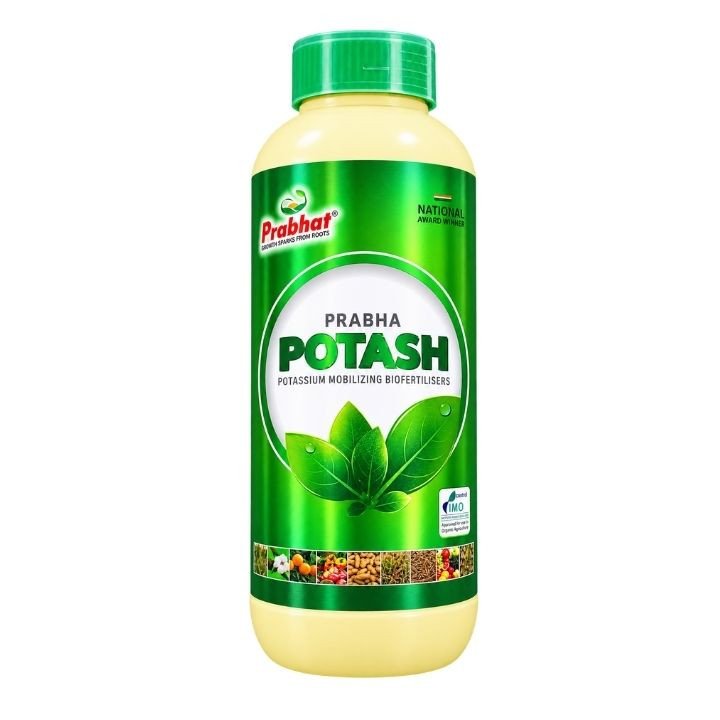
Prabhat Prabha Potash is an eco-friendly Potassium Mobilizing Biofertilizer containing beneficial bacteria Frateuria aurantia. These beneficial microorganisms colonize the rhizosphere around plant roots and help convert unavailable or insoluble forms of potassium present in the soil into forms that plants can absorb more efficiently.
Potassium is an essential plant nutrient required for several physiological processes, including water regulation, enzyme activity, carbohydrate movement, crop quality and tolerance to environmental stress. By improving the availability of native soil potassium, Prabha Potash supports balanced crop nutrition, vigorous plant development and better crop performance.
Prabha Potash can be used in a wide range of crops including cereals, pulses, fruits, vegetables, oilseeds, flowers, cotton, sugarcane, tea, coffee and medicinal plants. It is also suitable for integration with other compatible biofertilizers as part of a balanced nutrient-management programme.
| Brand | Prabhat |
| Product Name | Prabha Potash |
| Product Category | Biofertilizer |
| Biofertilizer Type | Potassium Mobilizing Biofertilizer |
| Beneficial Microorganism | Frateuria aurantia |
| Primary Function | Mobilization of Insoluble / Unavailable Soil Potassium |
| Area of Activity | Rhizosphere / Root Zone |
| Product Type | Microbial Biofertilizer |
| Available Formulations | Liquid, Powder and Granular |
| Suitable Crops | Suitable for a Wide Range of Agricultural and Horticultural Crops |
Frateuria aurantia is a beneficial potassium-mobilizing microorganism. After application, the bacteria establish themselves in the rhizosphere, the soil region immediately surrounding plant roots.
The microorganisms help release potassium from minerals and other less-available soil sources through biological activity. This improves the availability of potassium in the root zone, allowing plants to absorb and utilize the nutrient more efficiently.
Potassium is one of the major essential nutrients required for healthy plant development. Unlike nitrogen and phosphorus, potassium does not become a structural component of plant tissues, but it plays an important regulatory role in many physiological processes.
| Crop Category | Suitable Crops |
|---|---|
| Pulses | Beans, Mung, Lentil, Gram and Other Pulses |
| Cereals | Wheat, Paddy, Maize, Barley, Oat, Sorghum and Other Cereals |
| Fruit Crops | Apple, Grapes, Banana, Pomegranate, Papaya, Guava, Strawberry, Citrus and Other Fruits |
| Vegetables | Potato, Brinjal, Tomato, Cauliflower, Okra, Capsicum, Onion, Cabbage, Ginger, Peas and Other Vegetables |
| Plantation Crops | Coffee and Tea |
| Commercial Crops | Sugarcane, Sugar Beet and Cotton |
| Other Crops | Flowers, Oilseeds, Medicinal Plants and Other Suitable Crops |
In paddy, Prabha Potash can be incorporated into a balanced nutrient-management programme to improve the availability of potassium in the root zone. Adequate potassium supports crop vigour, grain development and overall plant health.
Potassium plays an important role in wheat growth, water regulation and grain development. Potassium-mobilizing bacteria can help improve utilization of potassium already present in the soil.
Vegetable crops require balanced potassium nutrition during vegetative development, flowering and fruit formation. Prabha Potash can be used in crops such as tomato, brinjal, potato, capsicum, okra, onion, cauliflower, cabbage, ginger and peas as part of an integrated nutrient-management programme.
Fruit crops often require significant potassium for fruit development and quality. Prabha Potash can be incorporated into nutrient programmes for crops such as grapes, banana, pomegranate, papaya, guava, strawberry, citrus and apple.
Prabha Potash is available in different formulations to suit various agricultural application methods:
The product shown here is the liquid formulation. Application quantity can differ according to formulation, crop and application method.
Prabha Potash may be applied through suitable agricultural methods according to the formulation and directions provided on the original product label.
The recommended quantity may be mixed with well-decomposed farmyard manure, compost or another suitable carrier and applied around the crop root zone as directed on the label.
Where specifically permitted on the product label, suitable liquid formulations may be applied through compatible irrigation systems according to the manufacturer's instructions.
The product may be directed toward the active root zone so that beneficial microorganisms can establish in the rhizosphere.
Important: Always follow the exact crop-wise dose and application method printed on the current Prabha Potash bottle, packet or leaflet.
The exact dosage of Prabha Potash depends on the formulation being used, crop, soil condition and application method.
Do not use a generalized dose without checking the current product label. Follow the manufacturer's recommended quantity for the specific liquid, powder or granular formulation being purchased.
Prabha Potash is intended to be compatible with suitable biofertilizer programmes. However, because it contains living beneficial microorganisms, care should be taken when combining it with antimicrobial crop-protection chemicals.
Prabha Potash can be used as part of an Integrated Nutrient Management (INM) programme along with soil testing, organic manure, crop residues and appropriately recommended mineral fertilizers.
Biofertilizers should generally complement a balanced nutrient programme rather than being treated as a guaranteed replacement for all conventional potassium fertilizer requirements.
The manufacturer describes Prabha Potash as helping improve utilization of soil potassium and potentially reducing dependence on conventional potash inputs under appropriate soil and crop conditions.
Note: Any reduction in conventional potash fertilizer should be based on soil-test results, crop requirement and qualified agricultural recommendations. Fertilizer savings can vary significantly between fields and crops.
Prabha Potash is a Potassium Mobilizing Biofertilizer containing beneficial microorganisms that help improve the availability of soil potassium to crops.
Prabha Potash contains the beneficial potassium-mobilizing bacterium Frateuria aurantia.
It helps mobilize less-available forms of potassium present in soil, making potassium more accessible to plant roots.
No. It is a microbial biofertilizer based on beneficial potassium-mobilizing bacteria.
It should not automatically be considered a complete replacement for all conventional potash fertilizer. Potassium requirements should be determined according to crop requirement, soil testing and agricultural recommendations.
It is suitable for a broad range of crops including cereals, pulses, vegetables, fruits, cotton, sugarcane, tea, coffee, oilseeds, flowers and medicinal plants.
Yes. It can be incorporated into nutrient-management programmes for vegetables such as tomato, brinjal, potato, cauliflower, okra, capsicum, onion, cabbage, ginger and peas.
Yes. It can be used for crops such as grapes, banana, pomegranate, papaya, guava, strawberry, citrus and apple according to product recommendations.
Yes. Paddy and wheat are among the cereal crops for which potassium-mobilizing biofertilizers can be incorporated into a balanced nutrient-management programme.
No. The product is described as being available in liquid, powder and granular formulations. The product shown here is a liquid formulation.
Yes, it can generally be integrated with compatible biofertilizers. Always follow the manufacturer's compatibility instructions.
Improved potassium availability can support crop growth and yield potential. Actual results depend on soil fertility, crop requirement, climate, irrigation, nutrition and overall crop management.
The correct dose depends on whether liquid, powder or granular Prabha Potash is being used. Always follow the exact dose printed on the current product label rather than applying an estimated quantity.
The above information is intended for product-page and general agricultural awareness purposes. Product performance and fertilizer-saving potential can vary according to crop, soil potassium status, microbial activity, climate, irrigation, nutrient management and other field conditions. Always follow the current Prabha Potash product label, soil-test recommendations and qualified agricultural advice for dosage, application method, compatibility and nutrient management.
No reviews yet.