

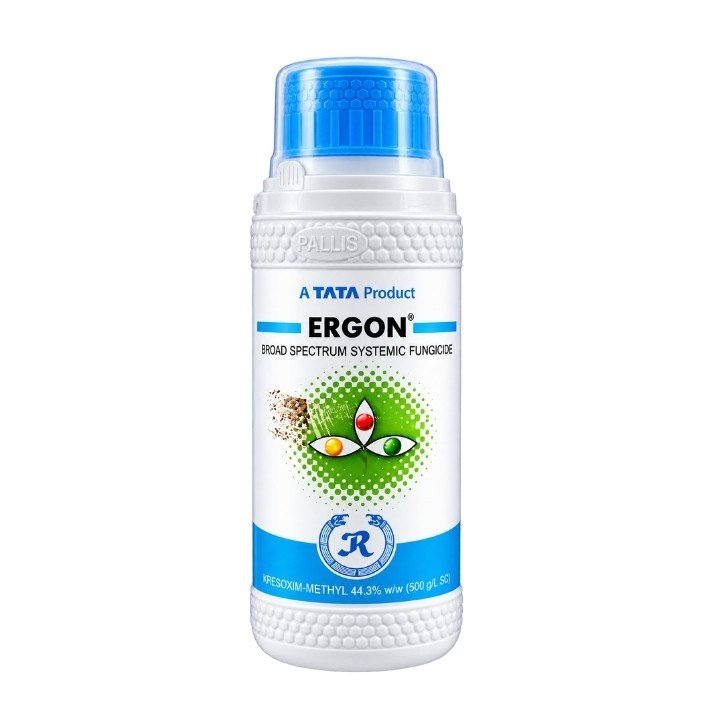
Tata Ergon Fungicide - Kresoxim-methyl 44.3% SC Systemic
Tata Ergon Kresoxim-methyl 44.3% SC Systemic Fungicide
Tata Ergon is a broad-spectrum systemic fungicide containing Kresoxim-methyl 44.3% w/w, equivalent to 500 g/L, SC. It is manufactured and marketed by Rallis India Limited, a Tata enterprise, for managing important fungal diseases in rice, grapes, chilli, soybean, potato, cotton, wheat and maize.
Ergon belongs to the strobilurin or QoI fungicide group. It helps control disease by interfering with fungal respiration, inhibiting spore germination and restricting fungal growth. Its translaminar movement, surface redistribution and vapour activity support effective coverage of treated plant parts.
Timely application helps protect healthy plant tissue, preserve functional green leaf area and support crop yield and quality potential. For best performance, use Ergon preventively or during the initial stage of disease development.
Tata Ergon Product Specifications
| Specification | Details |
|---|---|
| Product Name | Tata Ergon Fungicide |
| Brand | Tata / Rallis India Limited |
| Technical Name | Kresoxim-methyl 44.3% w/w SC |
| Equivalent Concentration | 500 g/L |
| Formulation | Suspension Concentrate (SC) |
| Product Type | Broad-spectrum systemic fungicide |
| Chemical Group | Strobilurin / Quinone Outside Inhibitor |
| FRAC Classification | Group 11 |
| Mode of Entry | Contact, translaminar and systemic redistribution |
| Application Method | Foliar spray |
| Labelled Application Stage | Early vegetative to reproductive stage |
| Re-entry Period | 24 hours after spraying |
Technical Composition
| Component | Concentration |
|---|---|
| Kresoxim-methyl active ingredient | 44.3% w/w, equivalent to 500 g/L |
| Formulation ingredients | Quantity sufficient to make the suspension concentrate |
Mode of Action
Kresoxim-methyl is a FRAC Group 11 Quinone Outside Inhibitor. It binds at the Qo site of the cytochrome bc1 complex and blocks electron transfer between cytochrome b and cytochrome c1 in fungal mitochondria.
Blocking mitochondrial electron transport disrupts ATP and energy production. This inhibits spore germination, fungal growth and development of the disease. The product is particularly effective when applied preventively or during the early stage of infection.
Crop, Disease, Dosage and Waiting Period
| Crop | Target Disease | Dose per Hectare | Approx. Dose per Acre | Water per Hectare | Waiting Period |
|---|---|---|---|---|---|
| Rice | Blast and sheath blight | 500 ml | Approximately 200 ml | 500 litres | 30 days |
| Grapes | Powdery mildew and downy mildew | 600–700 ml | Approximately 240–280 ml | 500 litres | 7 days |
| Chilli | Powdery mildew, fruit rot or anthracnose, dieback and twig blight | 500 ml | Approximately 200 ml | 500 litres | 3 days |
| Soybean | Rust | 500 ml | Approximately 200 ml | 500 litres | 43 days |
| Potato | Late blight and early blight | 500 ml | Approximately 200 ml | 500 litres | 23 days |
| Cotton | Leaf spot and grey mildew | 500 ml | Approximately 200 ml | 500 litres | 26 days |
| Wheat | Rust and leaf blight | 500 ml | Approximately 200 ml | 500 litres | 34 days |
| Maize | Turcicum leaf blight and rust | 500 ml | Approximately 200 ml | 500 litres | 25 days |
Dose-conversion note: Acre doses are rounded conversions from the registered hectare recommendations. Always give priority to the dose printed on the supplied Ergon label.
Application Frequency
The registered label permits 2–3 foliar sprays, depending on disease pressure. The actual number and interval should be based on disease severity, crop stage, weather, previous application and label directions.
Do not repeat Ergon continuously without rotating to an effective fungicide having a different FRAC mode-of-action group.
Key Features of Tata Ergon
- Broad-Spectrum Activity: Registered against important blast, blight, mildew, rust, rot and leaf-spot diseases.
- Systemic Redistribution: Moves within treated plant tissue to support disease protection.
- Translaminar Action: Moves across the treated leaf to improve protection of both surfaces.
- Vapour Redistribution: Vapour-phase movement supports coverage around the treated surface.
- Spore-Germination Inhibition: Helps stop disease before successful infection and establishment.
- Preventive Performance: Particularly effective when used before infection or at the first disease symptoms.
- Residual Activity: Provides continued protection for a period influenced by crop growth, disease pressure and weather.
- Greening Effect: Disease control helps maintain healthy, functional green leaf area.
Benefits for Farmers
- Controls multiple labelled fungal diseases across eight important crops.
- Helps preserve healthy foliage and photosynthetic area.
- Supports crop vigour by reducing fungal-disease stress.
- Protects economically important leaves, stems, grains, fruits and tubers.
- Helps maintain yield and produce-quality potential under proper crop management.
- Provides contact, systemic, translaminar and vapour redistribution properties.
- Suitable for integration into a planned disease-management programme.
Crop-Wise Uses
Ergon for Rice
In rice, Ergon is registered for blast and sheath blight. Apply at the early stage of disease using 500 ml per hectare in 500 litres of water.
Ergon for Grapes
In grapes, Ergon controls powdery mildew and downy mildew. Use 600–700 ml per hectare according to disease pressure and label directions. Thorough coverage of foliage and bunch-bearing portions is important.
Ergon for Chilli
In chilli, Ergon is registered for powdery mildew, fruit rot or anthracnose, dieback and twig blight. Use 500 ml per hectare as an evenly applied foliar spray.
Ergon for Soybean
In soybean, it is recommended for rust management. Early intervention helps protect functional foliage during crop and pod development.
Ergon for Potato
In potato, Ergon is registered against early and late blight. Begin disease management according to field monitoring and locally favourable infection conditions.
Ergon for Cotton
In cotton, Ergon controls leaf spot and grey mildew. Disease management helps retain productive foliage during crop development.
Ergon for Wheat
In wheat, Ergon is recommended against rust and leaf blight. Apply during the labelled crop stage and observe the 34-day waiting period.
Ergon for Maize
In maize, Ergon is registered for Turcicum leaf blight and rust. Uniform foliar coverage is necessary for effective protection.
Best Time to Apply Ergon
- Apply preventively when environmental conditions favour the target disease.
- Begin treatment when the first disease symptoms are detected.
- Do not wait until the disease becomes severe throughout the field.
- Apply during the early vegetative to reproductive crop stage as permitted by the label.
- Spray during early morning or evening when wind speed is low.
- Avoid application immediately before rainfall.
How to Use Tata Ergon Fungicide
- Identify the crop disease correctly before selecting the treatment.
- Confirm that the crop and disease are listed on the Ergon label.
- Measure the product according to the treated area and crop-specific dose.
- Wear the personal protective equipment specified on the label.
- Shake the Ergon container thoroughly before measuring.
- Half-fill the spray tank with clean water.
- Add the measured fungicide while maintaining agitation.
- Add the remaining required water and mix thoroughly.
- Spray the crop uniformly, covering both upper and lower foliage.
- Avoid excessive runoff and drift to neighbouring areas.
- Maintain tank agitation throughout the application.
- Use the prepared spray mixture on the same day.
Resistance Management
Kresoxim-methyl belongs to FRAC Group 11. Repeated application of Group 11 fungicides can select resistant fungal populations. Ergon should therefore be used within an integrated disease- and resistance-management programme.
- Do not exceed the number of applications permitted on the product label.
- Avoid repeated consecutive applications of Ergon or another Group 11 fungicide.
- Rotate with an effective fungicide having a different FRAC mode of action.
- Use the complete recommended dose and obtain thorough spray coverage.
- Apply preventively or at the beginning of infection.
- Combine fungicide use with resistant varieties, sanitation and balanced crop nutrition.
Compatibility and Tank Mixing
Tank mixing may be considered only when the labels of all products permit the combination. Conduct a small jar test before preparing an unfamiliar mixture. Do not use mixtures that produce sediment, flakes, heat, excessive foam or separation.
Compatibility does not automatically confirm crop safety or biological effectiveness. Obtain crop-specific expert advice before combining Ergon with unfamiliar pesticides or fertilizers.
Rainfastness
Ergon is known for good retention and redistribution after drying. However, a fixed rainfastness period is not stated in the available registered label information. Allow sufficient drying time and avoid spraying immediately before expected rainfall.
Re-entry and Pre-Harvest Safety
| Safety Requirement | Label Direction |
|---|---|
| Re-entry Period | Do not enter the treated crop for 24 hours after spraying without appropriate protection |
| Pre-Harvest Interval | Observe the crop-specific waiting period stated in the dosage table |
| Unlisted Crops | Do not use on crops other than those specified on the current label |
Safety Precautions
- Read the complete label and leaflet before opening the container.
- Wear suitable gloves, protective clothing, footwear and eye protection.
- Avoid breathing spray mist and prevent contact with skin and eyes.
- Do not eat, drink, smoke or chew while handling or spraying.
- Do not spray against the wind.
- Keep people and animals away from the treated field during application.
- Observe the label-specified 24-hour re-entry period.
- Do not contaminate ponds, streams or drinking-water sources.
- Wash hands, exposed skin, clothing and spraying equipment after use.
- Seek medical attention and show the product label if exposure causes illness.
Storage and Disposal
- Store Ergon in its original container with the cap securely closed.
- Keep in a cool, dry, locked and well-ventilated pesticide store.
- Protect from direct sunlight, moisture and excessive heat.
- Keep away from children, animals, food, beverages, seed and animal feed.
- Do not transfer the fungicide into food or beverage containers.
- Do not reuse an empty pesticide container.
- Dispose of empty packaging according to the label and applicable regulations.
Why Farmers Can Choose Tata Ergon
- Contains Kresoxim-methyl 44.3% w/w SC.
- Broad-spectrum systemic strobilurin fungicide.
- Registered for eight important agricultural crops.
- Controls blast, blight, mildew, rust, rot and leaf-spot diseases.
- Provides systemic, translaminar and vapour redistribution.
- Helps inhibit fungal spore germination and disease development.
- Clear crop-specific dosage and waiting-period recommendations.
Frequently Asked Questions
What is Tata Ergon used for?
Ergon is used for managing label-approved fungal diseases in rice, grapes, chilli, soybean, potato, cotton, wheat and maize.
What is the technical content of Ergon?
It contains Kresoxim-methyl 44.3% w/w, equivalent to 500 g/L, in a suspension concentrate formulation.
What is the Ergon dose per acre?
The approximate dose is 200 ml per acre for rice, chilli, soybean, potato, cotton, wheat and maize. For grapes, the approximate rate is 240–280 ml per acre. Follow the hectare dose printed on the label for accurate application.
What is the Ergon dose for rice?
Apply 500 ml per hectare, approximately 200 ml per acre, in 500 litres of water per hectare for blast and sheath blight.
What is the Ergon dose for grapes?
Apply 600–700 ml per hectare, approximately 240–280 ml per acre, in 500 litres of water per hectare for powdery and downy mildew.
How many times can Ergon be sprayed?
The label recommends 2–3 foliar applications depending on disease pressure. Rotate with a fungicide from a different FRAC group to manage resistance.
Is Ergon systemic or contact?
Ergon provides contact protection along with systemic and translaminar redistribution. Its vapour activity also contributes to movement around treated plant surfaces.
Does Ergon provide curative control?
Ergon is described as having protective, early curative and eradicative activity. Performance is generally best when it is applied preventively or at the beginning of infection. It cannot restore plant tissue that has already been severely damaged.
What is the re-entry period after spraying Ergon?
The registered label specifies a re-entry period of 24 hours after spraying.
What is the waiting period before harvest?
The waiting period is 3 days for chilli, 7 days for grapes, 23 days for potato, 25 days for maize, 26 days for cotton, 30 days for rice, 34 days for wheat and 43 days for soybean.
Can Ergon be mixed with other fungicides?
A tank mixture should be prepared only when the labels of all products permit it. Conduct a compatibility test and obtain expert advice before combining unfamiliar products.
Buy Tata Ergon Kresoxim-methyl 44.3% SC Fungicide Online
Choose Tata Ergon for systemic and translaminar management of labelled blast, blight, mildew, rust, fruit rot, dieback and leaf-spot diseases. Apply during the early disease stage using the crop-specific dose, water volume, application frequency and waiting period stated on the label.
Disclaimer: This information is provided for general agricultural guidance only. Always follow the current product container and accompanying leaflet for approved crops, diseases, dosage, application frequency, re-entry period, pre-harvest interval and safety precautions. Do not use the product on any crop not specified on the label.
Similar Products
Best Selling
Customer Reviews
Recent Reviews
No reviews yet.