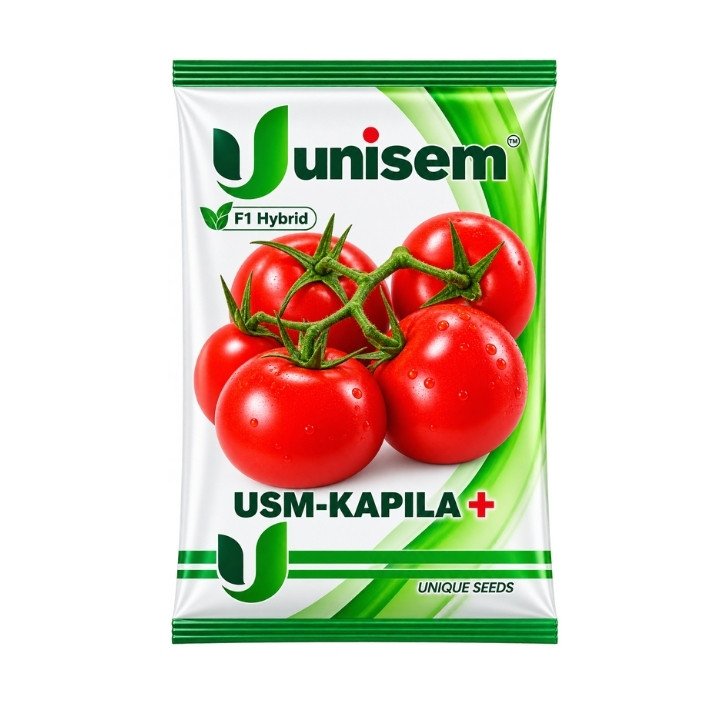
USM-Kanchana F1 is a premium hybrid tomato variety developed for high yield, uniform round fruits, and excellent shelf life. The fruits are bright red with smooth, glossy skin and a firm texture—making them ideal for fresh markets as well as cooking. Plants are vigorous with strong stems and dense foliage cover for protection against sunscald. This hybrid performs well in both main and off-season cultivation under proper crop management.
| Attribute | Details |
|---|---|
| Brand | USM |
| Variety | Kanchana F1 (Hybrid) |
| Crop | Tomato (Solanum lycopersicum) |
| Fruit Traits | Large, round, bright red fruits with smooth glossy skin; firm and juicy texture |
| Yield Potential | High; produces uniform clusters consistently during the harvest period |
| Maturity / First Harvest* | Approximately 60–65 days after transplanting (depending on conditions) |
| Plant Habit | Vigorous growth with strong stems and good foliage cover; staking/trellising recommended |
| Adaptability | Suitable for main and off-season cultivation with proper nursery, nutrition, and crop protection |
| Sunlight Requirement | Full sun (6–8 hours per day) |
| Soil Type & pH | Fertile, well-drained soil; pH 6.0–7.5 |
| Moisture Needs | Moderate to high; maintain consistent soil moisture and avoid waterlogging |
| Sowing Method | Transplanting preferred; use healthy seedlings at 25–30 days |
| Spacing (field)* | ~60 × 45 cm (with staking); adjust as per local practices |
| Sowing Depth (nursery) | 0.5–1.0 cm; light soil cover and gentle watering recommended |
| Storage | Store seeds in a cool, dry place away from sunlight and moisture |
| Country of Origin | India |
*Indicative values; always follow the product packet/leaflet and local agronomic advisories.
Q1: When is the first harvest available?
A1: Under normal conditions, the first picking begins about 60–65 days after transplanting.
Q2: Can this variety be grown in the off-season?
A2: Yes. With proper nursery management, mulching, staking, and protection measures, it performs well in off-season conditions too.
Q3: What spacing and training system should be followed?
A3: Field spacing of ~60 × 45 cm is recommended with staking. Training plants with 1–2 stems and timely pruning improves fruit quality and airflow.
Q4: What stage is best for harvesting to ensure longer shelf life?
A4: Harvesting at breaker or pink stage and storing in ventilated crates helps improve shelf life and transportability.
Q5: How can fruit cracking or Blossom End Rot (BER) be prevented?
A5: Maintain uniform irrigation, use mulching, supplement with Calcium and Boron, and avoid sudden moisture fluctuations.
Q6: What about disease tolerance?
A6: The hybrid shows good field tolerance. However, it is advisable to follow Integrated Pest Management (IPM) practices—clean nursery, crop rotation, and timely sprays as per local recommendations.
Q7: Can it be grown in pots or balconies?
A7: Yes. Use containers at least 25–30 cm deep with a rich potting mix, provide staking, regular feeding, and ensure 6–8 hours of sunlight daily.
Disclaimer: The information provided above is intended for reference purposes only. For correct application and growing practices, always follow the official directions on the product packaging and leaflet.
No reviews yet.