

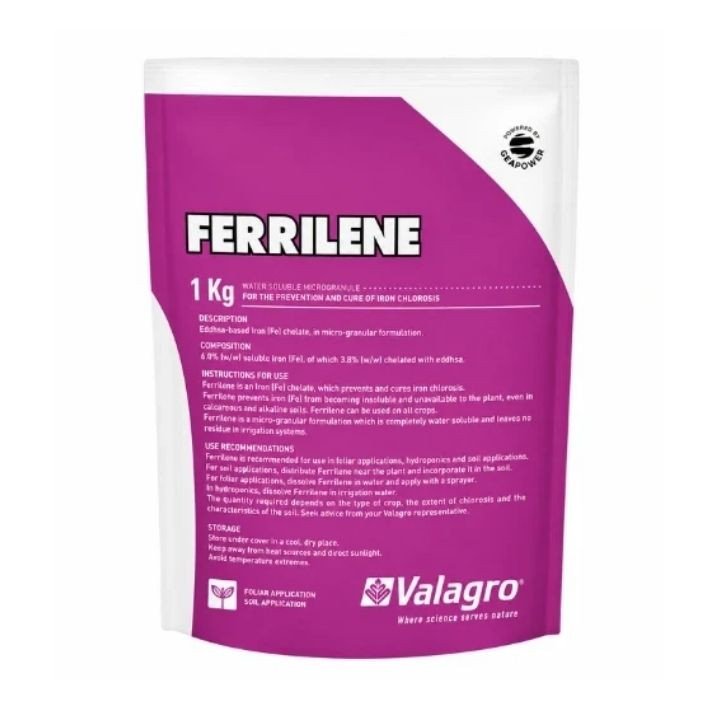
Valagro Ferrilene Micronutrient – Chelated Iron 6%
EDDHSA Chelated Iron Micronutrient for Iron Deficiency and Chlorosis
Valagro Ferrilene is a specialised chelated iron micronutrient fertilizer containing 6% water-soluble Iron (Fe). It uses EDDHSA chelation technology to help maintain iron availability in the root zone and support efficient iron nutrition under a wide range of soil conditions.
Ferrilene is designed for the prevention and correction of iron deficiency and iron chlorosis. Its soluble microgranular formulation is suitable for root application and fertigation, helping crops receive available iron where soil conditions may otherwise restrict normal uptake.
Product Specifications
| Product Name | Ferrilene |
|---|---|
| Brand | Valagro |
| Product Type | Chelated Iron Micronutrient Fertilizer |
| Primary Nutrient | Iron (Fe) |
| Water-Soluble Iron | 6.0% |
| Chelating Agent | EDDHSA |
| EDDHSA-Chelated Iron | 3.8% |
| Chelated Fraction | 100% |
| Formulation | Soluble Microgranules |
| Application Method | Root Application / Fertigation |
| Primary Use | Prevention and Correction of Iron Deficiency and Iron Chlorosis |
| Chelate Stability Range | pH 4–10 |
Technical Composition
| Component | Content |
|---|---|
| Water-Soluble Iron (Fe) | 6.0% |
| Iron Chelated with EDDHSA | 3.8% |
| Total Chelated Fraction | 100% |
| Chelating Agent | EDDHSA |
Key Features of Valagro Ferrilene
- 6% Water-Soluble Iron: Provides readily available iron nutrition to crops.
- EDDHSA Chelation: Helps protect iron from becoming unavailable in the soil.
- Iron Chlorosis Management: Specially developed to prevent and correct symptoms associated with iron deficiency.
- Wide pH Stability: Chelated iron remains stable across a pH range of approximately 4–10.
- Root Application: Designed for efficient delivery of iron through the crop root zone.
- Fertigation Suitable: Soluble microgranules can be incorporated into suitable fertigation programs.
- Broad Crop Use: Suitable for fruit crops, vegetables, field crops, flowers and other crops according to crop requirement.
Benefits of Ferrilene
- Helps prevent and correct iron deficiency.
- Helps reduce symptoms of iron chlorosis.
- Supports chlorophyll formation and healthy green foliage.
- Supports normal photosynthesis and crop growth.
- Helps maintain iron availability under challenging soil conditions.
- Supports healthy vegetative development.
- Provides highly efficient root-zone iron nutrition.
- Can be incorporated into balanced micronutrient programs.
Importance of Iron in Plants
| Plant Function | Role of Iron |
|---|---|
| Chlorophyll Formation | Iron supports processes necessary for normal chlorophyll development. |
| Photosynthesis | Supports electron-transfer processes involved in photosynthesis. |
| Respiration | Participates in important enzymatic and energy-related plant processes. |
| Plant Metabolism | Supports several enzymes and metabolic reactions required for healthy growth. |
| Vegetative Growth | Supports healthy leaf development and crop vigour where iron availability is adequate. |
Iron Chlorosis Management
Iron chlorosis commonly appears as yellowing between the veins of young leaves while the veins remain comparatively green. Because iron has limited mobility within many plants, symptoms are often first visible on newly developing foliage.
Ferrilene supplies iron in a chelated form that helps maintain availability in the root zone, making it useful where soil conditions restrict the uptake of naturally occurring iron.
Common Symptoms of Iron Deficiency
- Yellowing of young leaves.
- Green veins remaining visible against pale leaf tissue.
- Interveinal chlorosis.
- Reduced leaf greenness.
- Weak vegetative development under severe deficiency.
- Reduced photosynthetic activity.
- Poor crop vigour where deficiency remains uncorrected.
Why Iron Can Become Unavailable in Soil
A soil may contain iron but still fail to provide enough available iron to crops. Soil pH, carbonate levels, moisture conditions and the chemical form of iron can influence its availability to plant roots.
Iron deficiency is particularly common in alkaline and calcareous soils, where unchelated iron can rapidly become unavailable. EDDHSA chelation helps maintain iron in a form that can remain available for root uptake over a broad soil pH range.
What is EDDHSA Chelation?
EDDHSA is an iron-chelating agent that forms a stable complex around iron ions. This helps protect the iron from reactions in the soil that could otherwise convert it into forms that plants cannot easily absorb.
Valagro uses EDDHSA technology in Ferrilene to provide high agronomic efficiency and support correction of iron chlorosis through root-zone application.
Recommended Crops and Application Rates
| Crop Group | Valagro Reference Rate |
|---|---|
| Pome Fruit Crops | 10–30 kg/ha |
| Stone Fruit Crops | 10–30 kg/ha |
| Strawberry | 5–15 kg/ha |
| Citrus | 10–30 kg/ha |
| Table Grapes | 10–30 kg/ha |
| Kiwi Fruit | 10–30 kg/ha |
| Vegetables & Row Crops | 5–15 kg/ha |
| Flower Crops | 5–15 kg/ha |
| Potted Plants | 0.5–2 g per plant |
The recommended rate depends on crop size, severity of iron chlorosis, soil conditions and cultivation system. Always adjust the application according to the current product label and local crop recommendations.
How to Apply Valagro Ferrilene
- Identify iron deficiency through visible symptoms, soil testing or plant-tissue analysis where possible.
- Select the appropriate crop-specific rate according to deficiency severity.
- Dissolve Ferrilene thoroughly in clean water.
- Apply through the recommended fertigation or root-zone application method.
- Distribute the solution uniformly around the active root zone.
- Maintain suitable irrigation and soil moisture after application.
- Monitor new plant growth to assess correction of deficiency symptoms.
Root-Zone Application
Ferrilene is intended primarily for root application. Delivering chelated iron to the active root zone allows the nutrient to remain available in soil solution where growing roots can absorb it.
Uniform distribution around the root zone is important, particularly in perennial fruit crops where the active feeder roots may extend across a larger soil area.
Fertigation Application
The soluble microgranular formulation makes Ferrilene suitable for fertigation where the irrigation system and crop program permit. Dissolve the required quantity thoroughly and distribute it evenly through the irrigation system.
Application rates should be based on crop requirement and the severity of iron deficiency rather than using excessive quantities.
Best Time to Apply
Ferrilene can be used preventively in soils or crops with a known history of iron chlorosis or applied when early deficiency symptoms become visible.
Early correction is generally preferable because prolonged iron deficiency can reduce chlorophyll formation, photosynthesis and normal vegetative development.
Factors Affecting Application Rate
- Crop species and variety.
- Plant age and crop biomass.
- Severity of iron chlorosis.
- Soil pH and carbonate content.
- Root-zone conditions.
- Irrigation and fertigation practices.
- Previous history of iron deficiency.
Compatibility
When incorporating Ferrilene into a fertigation or crop nutrition program, check compatibility with other fertilizers and agricultural inputs before preparing a complete mixture.
- Use clean water for preparation.
- Dissolve the product completely before application.
- Check compatibility before combining with unfamiliar inputs.
- Follow the instructions of all products included in a nutrient mixture.
- Avoid exceeding the recommended application rate.
Why Farmers Can Choose Valagro Ferrilene
- Valagro specialised chelated iron micronutrient.
- Contains 6% water-soluble iron.
- Uses EDDHSA chelation technology.
- 100% chelated fraction.
- Stable across a broad soil pH range.
- Helps prevent and correct iron chlorosis.
- Suitable for root application and fertigation.
- Useful for agricultural and horticultural crops.
Frequently Asked Questions
Q1. What is Valagro Ferrilene?
Valagro Ferrilene is an EDDHSA-chelated iron micronutrient fertilizer developed for prevention and correction of iron deficiency and iron chlorosis.
Q2. How much iron does Ferrilene contain?
Ferrilene contains 6% water-soluble iron, with 3.8% iron chelated using EDDHSA.
Q3. What is Ferrilene mainly used for?
It is used to supply available iron to crops and help prevent or correct iron deficiency and iron chlorosis.
Q4. What is iron chlorosis?
Iron chlorosis is a nutritional condition commonly characterised by yellowing between the veins of young leaves due to insufficient available iron.
Q5. Is Ferrilene suitable for alkaline soil?
Ferrilene's EDDHSA-chelated iron is designed to remain stable across a broad pH range, making it useful where soil conditions restrict normal iron availability.
Q6. What is the stable pH range of Ferrilene?
Valagro technical information states that the EDDHSA iron chelate is stable approximately between pH 4 and 10.
Q7. How should Ferrilene be applied?
Ferrilene is primarily intended for root-zone application and fertigation.
Q8. Can Ferrilene be used on vegetable crops?
Yes. Valagro provides application guidance for vegetables and row crops as part of the Ferrilene crop nutrition program.
Q9. Can Ferrilene be used on fruit crops?
Yes. Valagro lists pome fruits, stone fruits, citrus, grapes, kiwi and other fruit crops in its Ferrilene application guidance.
Q10. Does Ferrilene help make yellow leaves green?
Where yellowing is caused by iron deficiency, supplying available chelated iron can support chlorophyll formation and recovery of healthy new foliage. Yellowing caused by other nutrient, disease or root problems requires appropriate diagnosis.
Q11. Is Ferrilene a foliar fertilizer?
Valagro primarily recommends Ferrilene for root application and fertigation rather than foliar use.
Q12. Is Ferrilene a pesticide?
No. Ferrilene is a chelated iron micronutrient fertilizer used for crop nutrition and iron-deficiency management.
Valagro Ferrilene for Iron Deficiency and Iron Chlorosis Management
Valagro Ferrilene supplies 6% water-soluble iron through EDDHSA chelation technology to support efficient root-zone iron nutrition. It helps prevent and correct iron deficiency, supports chlorophyll formation and promotes healthy crop development where soil conditions restrict normal iron availability.
Disclaimer: The details provided are for informational guidance only. Always adhere to the recommended application instructions as stated on the product label and in the accompanying leaflet.
Similar Products

Best Selling
Customer Reviews
Recent Reviews
No reviews yet.