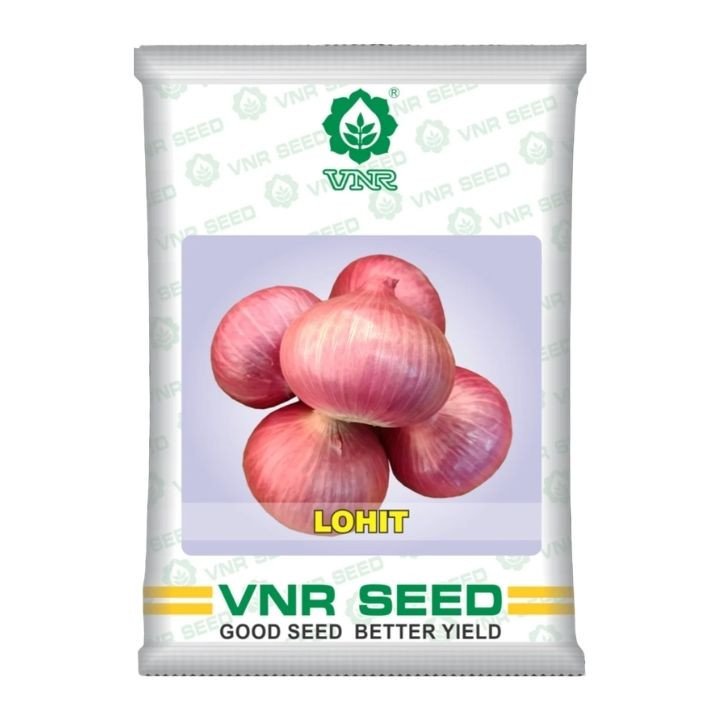
Two problems tend to define onion growing decisions more than most others — how fast the crop reaches harvest, and whether it holds up against bolting when conditions turn unfavorable. VNR Lohit, an open-pollinated (OP) red onion variety, is positioned specifically around both concerns. Its medium early maturity window means growers can realize returns relatively sooner compared to longer-duration varieties, while its documented bolting tolerance addresses one of the more frustrating failure points in onion cultivation — provided irrigation and fertilizer inputs are managed at optimum levels.
Being an OP variety rather than a hybrid also changes the economics slightly for growers who prefer saving seed across seasons, though performance consistency across saved-seed generations should still be evaluated against fresh certified seed on a season-by-season basis.
| Parameter | Detail |
|---|---|
| First Harvest | 100–105 Days |
| Seed Quantity per Acre | 1.5–2 kg |
| Sowing Distance (Row to Ridge) | 4–6 Inches |
| Plant to Plant Distance | 4–6 Inches |
Lohit produces a flat globe-shaped bulb in an attractive red color — a shape and color combination that tends to align well with market preference in most Indian onion trading circles. Its medium bulb size is specifically noted as suitable for both household consumers and HRC (Hotel, Restaurant, Catering) buyers, which gives growers some flexibility in where the harvest ultimately gets sold rather than being locked into one narrow market segment.
| Physical Trait | Specification |
|---|---|
| Color | Red |
| Shape | Flat Globe |
| Fruit Length | 4–6 cm |
| Fruit Width | 5–6 cm |
| Fruit Weight | 80–100 gm |
One detail worth paying close attention to: Lohit's bolting tolerance is described as excellent, but that claim is explicitly qualified — it holds "provided irrigation and fertilizer applications are kept to optimum levels." This isn't a minor footnote. Bolting (premature flowering) in onion is often triggered by stress conditions, including irregular watering or nutrient imbalance, so growers expecting bolting resistance to compensate for inconsistent field management may not see the variety's full potential in practice.
Lohit is recommended specifically for Kharif to Late Kharif season cultivation, which places it in a distinct window compared to Rabi-season onion varieties more commonly grown in parts of North India. All recommended fertilizer applications are meant to be completed within 75 to 80 days after transplanting — a fairly tight window that lines up with the crop's medium early maturity, since nutrient demand naturally tapers off as the bulb approaches its 100–105 day harvest target.
| Recommendation | Detail |
|---|---|
| Suitable Season | Kharif to Late Kharif |
| Fertilizer Completion Window | Within 75–80 Days After Transplanting |
With both row-to-ridge and plant-to-plant spacing set at 4–6 inches, Lohit follows a fairly standard onion spacing pattern that supports the medium bulb size the variety is bred for — tighter spacing than this can compress bulb development, while excessive spacing wastes field area without a corresponding yield benefit for this bulb size range.
Is Lohit suitable for Rabi season sowing as well as Kharif?
It's specifically recommended for Kharif to Late Kharif season use; growers considering Rabi cultivation should look for a variety bred and recommended for that season instead.
Does the bolting tolerance mean I can reduce irrigation frequency to save water?
No — the excellent bolting tolerance is specifically conditional on irrigation and fertilizer being maintained at optimum levels, so reducing irrigation could actually increase bolting risk rather than reduce management needs.
Is Lohit better suited for retail sale or bulk commercial buyers?
Its medium bulb size is noted as suitable for both household consumers and HRC (Hotel, Restaurant, Catering) buyers, giving reasonable flexibility across both market types.
How much seed do I need for a standard acre planting?
The recommended seed rate is 1.5–2 kg per acre, based on the standard 4–6 inch spacing guidance.
Disclaimer: The details provided are for informational guidance only. Always adhere to the recommended sowing and cultivation instructions as stated on the product label and in the accompanying leaflet.
No reviews yet.