

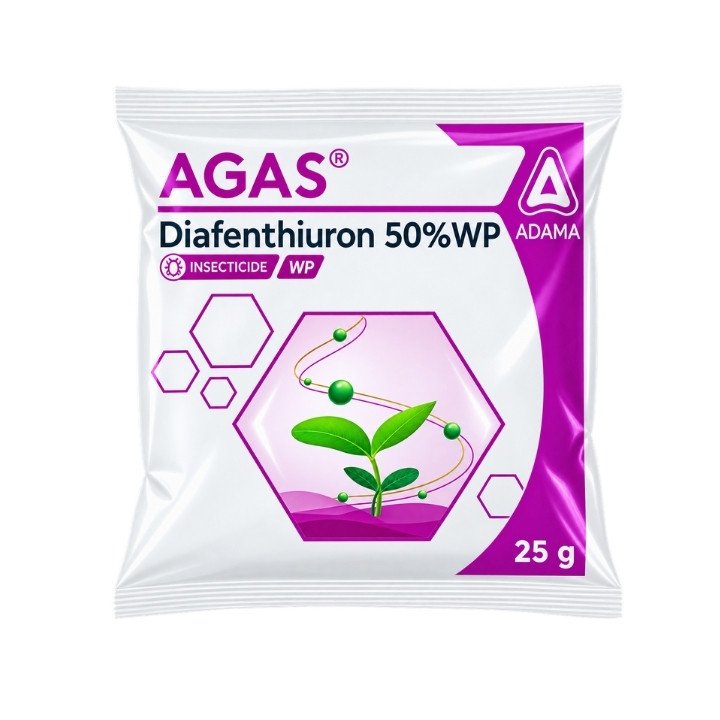
ADAMA Agas Insecticide – Diafenthiuron 50% WP
ADAMA Agas Diafenthiuron 50% WP Insecticide and Acaricide
ADAMA Agas is a broad-spectrum insecticide and acaricide containing Diafenthiuron 50% WP. It belongs to the thiourea chemical group and is intended for label-approved management of sucking insects, mites and selected caterpillar pests in several agricultural and horticultural crops.
Agas acts through contact and stomach activity and can affect susceptible larvae, nymphs and adults. It also provides some ovicidal activity. Its translaminar movement and vapour-phase effect help the treatment reach pests present on less-exposed portions and the lower surfaces of treated leaves.
ADAMA Agas Product Specifications
| Specification | Details |
|---|---|
| Product Name | ADAMA Agas |
| Brand | ADAMA |
| Technical Name | Diafenthiuron 50% WP |
| Active Ingredient | Diafenthiuron 50% w/w |
| Formulation | WP – Wettable Powder |
| Product Category | Insecticide and acaricide |
| Chemical Group | Thiourea |
| Mode of Entry | Contact and stomach action |
| Movement | Translaminar activity with vapour-phase effect |
| Mode of Action | Inhibitor of mitochondrial respiration |
| Target Life Stages | Susceptible eggs, larvae, nymphs and adults |
| Application Method | Foliar spray |
| Recommended Crops | Brinjal, cabbage, cardamom, chilli, citrus, cotton, okra, tomato and watermelon |
| Pack Size | Select the required available pack size |
Key Features of ADAMA Agas
- Dual-Purpose Protection: Works as both an insecticide and an acaricide.
- Broad-Spectrum Activity: Helps manage label-listed sucking insects, mites and selected caterpillar pests.
- Multiple Life-Stage Activity: Acts against susceptible larvae, nymphs and adults and also provides some ovicidal action.
- Contact and Stomach Action: Pests are exposed through direct spray contact or ingestion of treated plant tissue.
- Translaminar Movement: Moves across treated leaf tissue to improve coverage of pests feeding on the opposite leaf surface.
- Vapour-Phase Effect: Helps improve activity against insects and mites located in less-exposed parts of the foliage.
- Respiration Inhibitor: Disrupts mitochondrial energy production in susceptible pests.
- Beneficial-Insect Selectivity: ADAMA describes it as selective to beneficial insects and predatory mites when used according to label directions.
How ADAMA Agas Works
Diafenthiuron inhibits mitochondrial respiration in susceptible insects and mites. By disrupting energy production, it interferes with the pest’s normal physiological functions, leading to feeding cessation and mortality.
The formulation acts through direct contact and ingestion. Its translaminar activity helps distribute the active ingredient through treated leaf tissue, while its vapour-phase effect supports pest control in parts of the canopy that may be difficult to reach through direct spray alone.
Recommended Crops, Target Pests and Dosage
| Crop | Label-Listed Target Pests | Formulation Dose | Water Volume | Waiting Period |
|---|---|---|---|---|
| Cotton | Whiteflies, aphids, thrips and jassids | 600 g/ha | 500–1000 litres/ha | 21 days |
| Cabbage | Diamondback moth | 600 g/ha | 500–750 litres/ha | 7 days |
| Chilli | Mites | 600 g/ha | 500–750 litres/ha | 3 days |
| Brinjal | Whitefly | 600 g/ha | 500–750 litres/ha | 3 days |
| Cardamom | Thrips and capsule borer | 800 g/ha | 1000 litres/ha | 7 days |
| Watermelon | Whiteflies and red spider mites | 600 g/ha | 500 litres/ha | 5 days |
| Okra | Whiteflies, red spider mites and jassids | 600 g/ha | 500 litres/ha | 5 days |
| Tomato | Whiteflies and red spider mites | 600 g/ha | 500 litres/ha | 5 days |
| Citrus | Mites | 2 g per litre of water | Use sufficient water for uniform canopy coverage according to the label | 30 days |
Dosage caution: Crop recommendations, water volume and waiting periods should always be confirmed from the current Agas pack label and leaflet before application.
Approximate Per-Acre Dose
| Label Dose per Hectare | Approximate Dose per Acre |
|---|---|
| 600 g/ha | Approximately 243 g/acre |
| 800 g/ha | Approximately 324 g/acre |
Conversion note: Per-acre quantities are mathematical conversions only. Measure the treated area accurately and follow the dose printed on the current product label.
Benefits for Farmers
- Provides simultaneous insect and mite-management activity.
- Helps control different developmental stages of susceptible pests.
- Useful against important sucking pests such as whiteflies, aphids, thrips and jassids on label-approved crops.
- Provides acaricidal activity against label-listed mites.
- Translaminar movement supports coverage across treated leaf tissue.
- Vapour-phase action helps reach pests in less-exposed canopy locations.
- Can be used in several vegetable, fibre, spice and fruit crops according to its label.
- Its different biochemical action can support a properly planned insecticide-resistance management programme.
How to Apply ADAMA Agas
- Inspect the crop and confirm the pest before deciding to spray.
- Check that the crop and target pest appear on the current Agas label.
- Calculate the required product and water quantity from the accurately measured area.
- Wear the protective equipment specified on the product label.
- Half-fill the spray tank with clean water.
- Prepare a smooth slurry by mixing the measured wettable powder with a small quantity of water in a separate container.
- Add the slurry slowly to the spray tank while maintaining agitation.
- Add the remaining water and mix thoroughly.
- Spray the crop uniformly, including the lower leaf surfaces and inner canopy.
- Maintain agitation during spraying so the wettable powder remains evenly suspended.
- Do not spray during strong wind, expected rainfall or very hot afternoon conditions.
- Use the prepared spray solution on the same day.
Recommended Application Practices
- Apply when the target pest first reaches the locally recommended economic threshold.
- Ensure thorough foliage coverage because contact and translaminar activity depend on good deposition.
- Use a properly calibrated sprayer and suitable nozzle for uniform canopy coverage.
- Avoid excessive runoff from leaves.
- Do not use a higher dose or increase application frequency beyond label directions.
- Observe the crop-specific waiting period before harvesting.
- Do not enter the treated crop until the label-specified re-entry period has passed.
Insecticide-Resistance Management
Repeated use of insecticides with the same mode of action can select resistant pest populations. Use Agas as part of an integrated resistance-management programme and rotate it with effective products having a different mode-of-action group.
- Do not use Diafenthiuron repeatedly throughout the crop cycle.
- Avoid unnecessary calendar-based spraying.
- Use pest monitoring and economic thresholds to guide applications.
- Adopt cultural, mechanical and biological pest-management practices where appropriate.
- Preserve beneficial organisms by avoiding unnecessary insecticide applications.
- Follow local recommendations for the maximum number of applications.
Compatibility
Prepare a tank mixture only when the labels of all products permit the combination. Conduct a small jar test before preparing an unfamiliar mixture and seek advice from an agricultural specialist if compatibility is uncertain.
Do not mix Agas with strongly alkaline materials or any incompatible agrochemical unless the current label specifically allows it.
Safety Precautions
- Read the complete label and leaflet before use.
- Keep the product in its original, sealed and labelled container.
- Store securely away from children, food, feed and household articles.
- Avoid inhaling dust or spray mist.
- Prevent contact with skin, eyes and clothing.
- Do not eat, drink, smoke or chew while handling or spraying.
- Wear label-specified gloves, protective clothing, footwear and face protection.
- Wash exposed skin, equipment and contaminated clothing after spraying.
- Do not contaminate ponds, streams, drinking-water sources or animal feed.
- Never reuse an empty pesticide container.
Why Farmers Can Choose ADAMA Agas
- Contains Diafenthiuron 50% WP.
- Acts as both an insecticide and an acaricide.
- Provides contact and stomach activity.
- Offers translaminar movement and vapour-phase action.
- Acts against multiple developmental stages of susceptible pests.
- Recommended for nine label-listed agricultural and horticultural crops.
- Useful against whiteflies, mites and other important label-listed pests.
Frequently Asked Questions
What is the technical name of ADAMA Agas?
ADAMA Agas contains Diafenthiuron 50% WP.
Is Agas an insecticide or an acaricide?
It acts as both an insecticide and an acaricide, allowing control of label-listed insect pests and mites.
Which pests does Agas control?
Depending on the approved crop, its label includes pests such as whiteflies, aphids, thrips, jassids, mites, diamondback moth and cardamom capsule borer.
What is the dose of Agas per acre?
A label dose of 600 g/ha is approximately 243 g/acre, while 800 g/ha is approximately 324 g/acre. Citrus has a concentration-based recommendation of 2 g per litre of water. Always verify the exact crop recommendation from the current label.
Does Agas control insect eggs?
ADAMA states that it provides some ovicidal action in addition to activity against susceptible larvae, nymphs and adults.
What does translaminar action mean?
It means the active ingredient can move through treated leaf tissue and act against susceptible pests present on the opposite leaf surface.
Can Agas be used for whitefly control?
Yes. Whitefly is a label-listed target on crops including cotton, brinjal, watermelon, okra and tomato. Use only the crop-specific label dose.
Can Agas be used on chilli mites?
Yes. Mites on chilli are included in the listed recommendations, with a formulation dose of 600 g/ha. Confirm the current pack label before application.
Is Agas completely safe for beneficial insects?
ADAMA describes it as selective to beneficial insects and predatory mites. However, selectivity does not mean zero risk, so avoid unnecessary spraying and follow all label restrictions.
Can Agas be mixed with fungicides or fertilizers?
Mix it only when every product label permits the combination. Conduct a jar test and seek expert advice before combining unfamiliar products.
Disclaimer: The information provided is for general guidance only. Always adhere to the recommended crop, target pest, dose, water volume, waiting period and safety instructions stated on the current product label and accompanying leaflet.Similar Products


Best Selling

Customer Reviews
Recent Reviews
No reviews yet.