

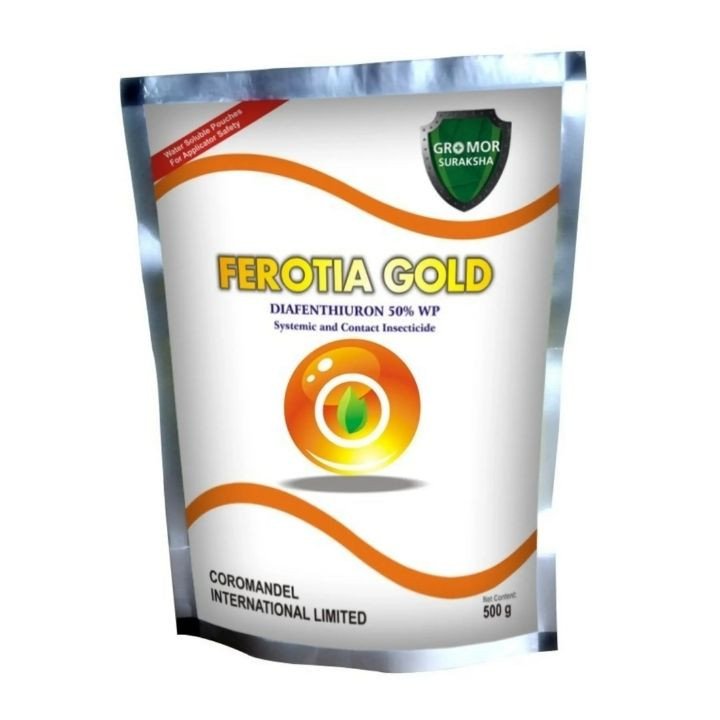
Coromandel Ferotia Gold Insecticide – Diafenthiuron 50% WP
Coromandel Ferotia Gold Insecticide contains Diafenthiuron 50% WP, a broad-spectrum insecticide and acaricide recommended for management of important sucking pests, mites and selected caterpillar pests across registered crops.
Ferotia Gold provides contact, stomach, translaminar and vapour-phase activity that helps reach pests feeding on exposed as well as less accessible plant surfaces. Diafenthiuron belongs to IRAC Group 12A and interferes with mitochondrial energy production in susceptible insects and mites.
Product Specifications
| Product Name | Ferotia Gold |
| Brand | Coromandel |
| Company | Coromandel International Limited |
| Product Type | Insecticide & Acaricide |
| Technical Name | Diafenthiuron 50% WP |
| Formulation | Wettable Powder (WP) |
| Chemical Group | Thiourea Group |
| IRAC Group | 12A |
| Mode of Action | Mitochondrial ATP Synthase Inhibitor |
| Application Method | Foliar Spray |
Technical Composition
Diafenthiuron 50% WP
Diafenthiuron belongs to the thiourea group of insecticides and acaricides. It is classified under IRAC Group 12A as an inhibitor of mitochondrial ATP synthase and affects energy production in susceptible insects and mites.
Key Features
- Contains Diafenthiuron 50% WP.
- Broad-spectrum activity against several sucking pests and mites.
- Helps manage nymph as well as adult stages of susceptible pests.
- Provides translaminar activity for pests occurring on the underside of leaves.
- Vapour-phase activity helps improve reach within dense crop canopies.
- Provides contact and stomach action with some ovicidal activity.
- Useful against pest populations that may be difficult to manage with repeatedly used older insecticide groups.
- Can be incorporated into an insecticide resistance-management programme when rotated appropriately.
Benefits of Coromandel Ferotia Gold
- Whitefly Management: Helps manage whitefly infestations in registered crops such as cotton, brinjal and watermelon.
- Sucking Pest Control: Useful against aphids, thrips and jassids in cotton.
- Mite Management: Provides acaricidal activity against mites in chilli, citrus and other registered uses.
- Hidden Pest Reach: Translaminar and vapour activity helps reach pests feeding on the underside of leaves and within dense crop foliage.
- Multiple Modes of Exposure: Provides contact and stomach activity against susceptible pests.
- Longer Pest Suppression: Coromandel positions Ferotia Gold for sustained control when applied according to the label.
Recommended Crops, Target Pests & Dosage
| Crop | Target Pest | Recommended Dose |
|---|---|---|
| Cotton | Whitefly, Aphids, Thrips and Jassids | 240 g per acre |
| Cabbage | Diamondback Moth | 240 g per acre |
| Chilli | Mites | 240 g per acre |
| Brinjal | Whitefly | 240 g per acre |
| Cardamom | Thrips and Capsule Borer | 320 g per acre |
| Citrus | Mites | 2 g per litre of water; approximately 2–3 litres spray solution per tree |
| Watermelon | Whitefly and Red Spider Mite | 240 g per acre |
Major Target Pests
- Whitefly
- Aphids
- Thrips
- Jassids
- Mites
- Red Spider Mites
- Diamondback Moth
- Capsule Borer
Dosage and Application
For most registered field-crop uses, Coromandel recommends approximately 240 g per acre. Cardamom is recommended at approximately 320 g per acre, while citrus carries a separate recommendation of approximately 2 g per litre of water.
Because the recommended dose differs by crop and pest, always calculate the application based on the specific crop and target pest rather than applying one general dose across all uses.
Mode of Action
Diafenthiuron is classified under IRAC Group 12A and acts as an inhibitor of mitochondrial ATP synthase. After activation, it interferes with energy production required for normal cellular functions in susceptible insects and mites.
The resulting energy disruption causes feeding and movement to decline, ultimately leading to paralysis and death of susceptible pests.
Ferotia Gold also provides contact and stomach activity, along with translaminar and vapour-phase movement that helps improve activity against pests located on less exposed parts of the crop canopy.
Translaminar & Vapour Action
One of the important characteristics of Ferotia Gold is its ability to act beyond the directly exposed upper leaf surface. Its translaminar activity helps the active ingredient move through treated leaf tissue, supporting management of pests feeding on the underside of leaves.
Coromandel also describes Ferotia Gold as having vapour action, which can help improve pest exposure within dense crop canopies when the product is applied according to label recommendations.
How to Use Coromandel Ferotia Gold
- Identify the target pest and confirm that the crop is included in the current Ferotia Gold label recommendation.
- Measure the required quantity according to the crop and field area.
- Take a small quantity of clean water in a separate container.
- Add the measured Ferotia Gold and mix thoroughly to prepare a smooth suspension.
- Partially fill the spray tank with clean water and add the prepared mixture.
- Add the remaining required water while maintaining agitation.
- Spray uniformly over the crop canopy with particular attention to areas where pests are active.
- Follow crop-specific waiting periods, application intervals and safety instructions on the current label.
Best Time to Apply
Apply Ferotia Gold when the target pest population reaches the locally recommended economic threshold or when infestation is detected at a manageable stage. Timely application generally provides better pest management than waiting for severe infestation.
Ensure adequate crop coverage and follow the current product label for application timing, repeat sprays and weather-related precautions.
Application Tips
- Ensure thorough and uniform spray coverage.
- Pay particular attention to the underside of leaves where whiteflies, mites and other sucking pests may remain hidden.
- Use properly calibrated spraying equipment.
- Use clean water to prepare the spray suspension.
- Avoid spraying during strong winds.
- Do not exceed the recommended crop-specific dose.
- Avoid mixing with highly acidic or strongly alkaline materials unless compatibility is confirmed.
- Rotate with insecticides from other IRAC groups where appropriate to support resistance management.
Compatibility
Coromandel describes Ferotia Gold as compatible with commonly used insecticides and fungicides, except products that are highly acidic or alkaline in nature. For any new tank mixture, always follow label instructions and verify compatibility before large-scale application.
Safety Precautions
- Read the complete product label and accompanying leaflet before use.
- Wear appropriate protective clothing, gloves, mask and eye protection during mixing and spraying.
- Avoid inhalation of powder and spray mist.
- Avoid direct contact with skin, eyes and mouth.
- Do not eat, drink or smoke while handling or applying the insecticide.
- Avoid contamination of ponds, streams and other water bodies.
- Wash hands, exposed skin and application equipment thoroughly after spraying.
- Keep securely stored away from children, food and animal feed.
Why Farmers Can Choose Coromandel Ferotia Gold
Coromandel Ferotia Gold Insecticide combines broad-spectrum pest activity with Diafenthiuron 50% WP chemistry for management of sucking pests, mites and selected caterpillar pests. Its translaminar, vapour, contact and stomach activity makes it useful for difficult-to-reach pests when applied according to crop-specific recommendations.
Frequently Asked Questions
Q1. What is Coromandel Ferotia Gold?
Coromandel Ferotia Gold is a broad-spectrum insecticide and acaricide containing Diafenthiuron 50% WP.
Q2. What is the technical composition of Ferotia Gold?
Ferotia Gold contains Diafenthiuron 50% WP.
Q3. What is the IRAC group of Diafenthiuron?
Diafenthiuron belongs to IRAC Group 12A and acts by inhibiting mitochondrial ATP synthase.
Q4. Which pests does Ferotia Gold help control in cotton?
Coromandel recommends Ferotia Gold in cotton against whitefly, aphids, thrips and jassids.
Q5. What is the Ferotia Gold dose for cotton?
Coromandel recommends approximately 240 g per acre for the registered cotton pests.
Q6. Can Ferotia Gold be used for mites in chilli?
Yes. Chilli mites are included in Coromandel's recommendations at approximately 240 g per acre.
Q7. Is Ferotia Gold recommended for whitefly in brinjal?
Yes. Coromandel lists brinjal whitefly as a registered-use recommendation at approximately 240 g per acre.
Q8. What is the dose of Ferotia Gold in citrus?
For citrus mites, Coromandel lists approximately 2 g per litre of water, using about 2–3 litres of spray solution per tree.
Q9. Does Ferotia Gold have translaminar action?
Yes. Coromandel describes Ferotia Gold as having translaminar activity that helps manage pests occurring on the underside of treated leaves.
Q10. Can Ferotia Gold be mixed with other pesticides?
Coromandel describes the product as compatible with commonly used insecticides and fungicides, except highly acidic or alkaline products. Always check the current label and compatibility before tank mixing.
Q11. Can Ferotia Gold be used on crops other than those listed?
Use Ferotia Gold only on crops and target pests permitted on the current product label. Do not extrapolate the dose to unlisted crops.
Coromandel Ferotia Gold Diafenthiuron 50% WP for Sucking Pests & Mites
Coromandel Ferotia Gold Insecticide with Diafenthiuron 50% WP is recommended for management of important pests including whitefly, aphids, thrips, jassids, mites, diamondback moth and capsule borer across registered crops. Its IRAC Group 12A mode of action, translaminar activity and vapour action make it a useful option for crop pest-management programmes when applied according to label recommendations.
Disclaimer: The details provided are for informational guidance only. Always adhere to the recommended application instructions as stated on the product label and in the accompanying leaflet.
Similar Products


Best Selling
Customer Reviews
Recent Reviews
Delivery fast thi.