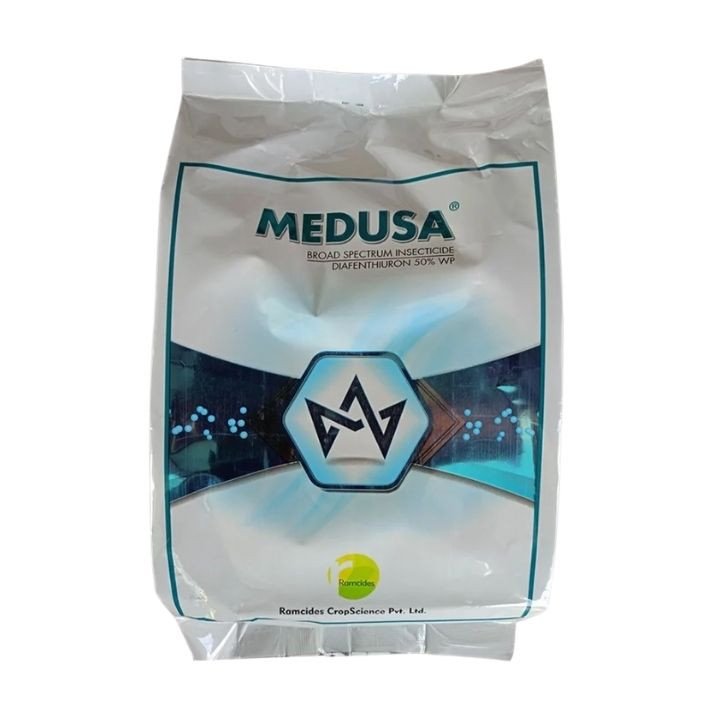

Ramcides Medusa is a broad-spectrum insecticide containing Diafenthiuron 50% WP. It belongs to the thiourea group and provides contact and stomach action against several important sucking pests, mites and selected caterpillar pests.
Medusa interferes with mitochondrial respiration in susceptible pests. After uptake, pest mobility, feeding and reproduction are affected, helping reduce further crop damage. It is recommended for crops such as cotton, cabbage, chilli, brinjal, cardamom, watermelon, okra, tomato and citrus according to the crop-specific label recommendation.
| Product Name | Medusa |
|---|---|
| Brand | Ramcides |
| Company | Ramcides CropScience Pvt. Ltd. |
| Technical Name | Diafenthiuron 50% WP |
| Product Type | Insecticide / Acaricide |
| Chemical Group | Thiourea |
| Formulation | WP - Wettable Powder |
| Mode of Action | Mitochondrial Respiration Inhibitor |
| Action | Contact and Stomach Action |
| Application Method | Foliar Spray |
| Active Ingredient | Diafenthiuron |
|---|---|
| Concentration | 50% |
| Formulation | Wettable Powder (WP) |
| Chemical Group | Thiourea |
| Crop | Target Pests | Dose / Hectare | Approx. Dose / Acre |
|---|---|---|---|
| Cardamom | Thrips, Capsule Borer | 800 g | Approx. 320 g |
| Cotton | Whitefly, Aphids, Thrips, Jassids | 600 g | Approx. 240 g |
| Cabbage | Diamond Back Moth | 600 g | Approx. 240 g |
| Brinjal | Whitefly | 600 g | Approx. 240 g |
| Chilli | Mites | 600 g | Approx. 240 g |
| Watermelon | Whitefly, Red Spider Mite | 600 g | Approx. 240 g |
| Okra | Whitefly, Red Spider Mite, Jassids | 600 g | Approx. 240 g |
| Tomato | Whitefly, Red Spider Mite | 600 g | Approx. 240 g |
| Citrus | Mites | 2 g per litre of water | As per spray-water requirement |
| Crop | Reference Water Volume / Hectare | Waiting Period |
|---|---|---|
| Cotton | 500–1000 L | 21 Days |
| Cabbage | 500–750 L | 7 Days |
| Chilli | 500–750 L | 3 Days |
| Brinjal | 500–750 L | 3 Days |
| Cardamom | 1000 L | 7 Days |
| Watermelon | 500 L | 5 Days |
| Okra | 500 L | 5 Days |
| Tomato | 500 L | 5 Days |
| Citrus | As per crop spray requirement | 30 Days |
Diafenthiuron acts by inhibiting mitochondrial respiration in susceptible insects and mites. This interferes with normal energy production required for movement, feeding and other essential biological functions.
Ramcides states that after uptake, pest mobility and reproduction cease and affected pests eventually become paralysed and die from starvation, generally over a period of several days.
Medusa is recommended for important sucking pests in crops such as cotton and okra. These pests remove plant sap and can reduce crop vigour when populations become high.
Timely foliar application with thorough and uniform coverage helps expose susceptible pests to Diafenthiuron and reduce continued crop damage.
Diafenthiuron provides acaricidal activity and is recommended against mites in crops such as chilli and citrus and against red spider mites in watermelon, okra and tomato.
Good spray coverage is particularly important because mites commonly feed on the undersides of leaves and other protected plant surfaces.
Ramcides Medusa is recommended against Diamond Back Moth in cabbage. Apply when pest infestation first appears and ensure uniform coverage of crop foliage.
Ramcides recommends applying Medusa at the appearance of pest infestation. Early treatment helps reduce pest feeding and population development before severe crop damage occurs.
Where another application is required due to continued infestation, Ramcides advises an interval of approximately 10–15 days, depending on pest pressure and the current label recommendation.
Ramcides states that Medusa is compatible with most commonly used products. However, compatibility may vary depending on the formulation and tank-mix partner.
Ramcides Medusa is a broad-spectrum insecticide and acaricide containing Diafenthiuron 50% WP.
It is recommended against pests including whitefly, aphids, thrips, jassids, mites, red spider mites, Diamond Back Moth and capsule borer depending on the crop.
The registered recommendation is 600 g per hectare, approximately 240 g per acre, against whitefly, aphids, thrips and jassids.
The registered recommendation is 600 g per hectare, approximately 240 g per acre, for Diamond Back Moth management.
For mites in chilli, the registered recommendation is 600 g per hectare, approximately 240 g per acre.
For mites in citrus, the registered recommendation is 2 g per litre of water.
Yes. Diafenthiuron provides acaricidal activity and Medusa is recommended against mites and red spider mites in several crops.
Diafenthiuron inhibits mitochondrial respiration in susceptible pests, disrupting energy production and affecting feeding, movement and survival.
Ramcides recommends spraying when target pest infestation first appears.
Where pest pressure continues, Ramcides advises repeat treatment after approximately 10–15 days according to infestation level and label instructions.
Ramcides officially describes Medusa as a broad-spectrum insecticide with contact and stomach action. Follow the current product label for its authorised mode-of-action claims.
Medusa is an insecticide and acaricide used to manage insect pests and mites. It is not a fungicide.
Ramcides Medusa Diafenthiuron 50% WP is a broad-spectrum insecticide and acaricide for management of important sucking pests, mites and selected caterpillar pests across recommended crops. Correct crop-specific dosage, timely application and thorough foliar coverage are important for effective pest management.
Disclaimer: The details provided are for informational guidance only. Always adhere to the recommended application instructions as stated on the product label and in the accompanying leaflet.
No reviews yet.