

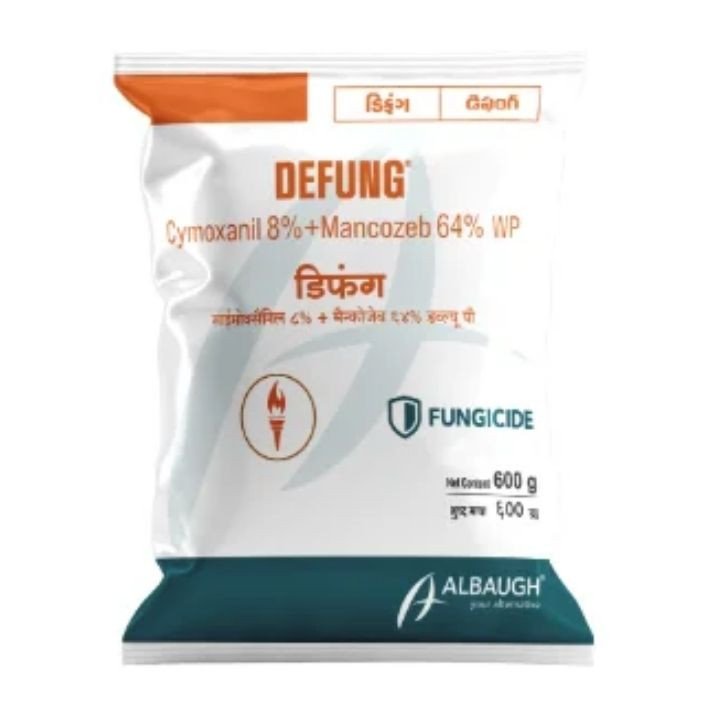
Albaugh Defung Fungicide (Cymoxanil 8% + Mancozeb 64% WP)
Locally Systemic and Contact Fungicide for Late Blight and Downy Mildew
Albaugh Defung Fungicide (Cymoxanil 8% + Mancozeb 64% WP) is a combination fungicide developed for management of important oomycete diseases in crops. It combines the locally systemic and curative activity of Cymoxanil with the broad-spectrum contact and protective activity of Mancozeb.
Albaugh recommends Defung for late blight in tomato and potato and downy mildew in grapes and cucumber. The formulation is also associated with registered use against gummosis or foot rot in citrus when applied according to the current product label.
Product Specifications
| Product Name | Defung |
|---|---|
| Brand | Albaugh |
| Product Type | Fungicide |
| Technical Name | Cymoxanil 8% + Mancozeb 64% WP |
| Formulation | Wettable Powder (WP) |
| Action | Locally Systemic + Contact |
| Activity | Protective and Curative |
| Major Targets | Late Blight, Downy Mildew and Citrus Gummosis |
| Application | Foliar Spray and Label-Recommended Citrus Treatment |
Technical Composition
| Active Ingredient | Concentration | Primary Role |
|---|---|---|
| Cymoxanil | 8% | Locally systemic, translaminar and curative activity |
| Mancozeb | 64% | Multi-site contact and protective activity |
| Formulation | Wettable Powder (WP) | |
Key Features of Albaugh Defung
- Dual-Action Fungicide: Combines Cymoxanil and Mancozeb for internal and surface-level disease management.
- Locally Systemic Activity: Cymoxanil penetrates treated plant tissues and provides activity around the point of application.
- Contact Protection: Mancozeb forms a protective fungicidal layer over treated plant surfaces.
- Protective Action: Helps prevent establishment of susceptible fungal and oomycete infections.
- Curative Activity: Cymoxanil provides useful early curative action after infection has begun.
- Late Blight Management: Recommended for late blight in tomato and potato.
- Downy Mildew Management: Recommended against downy mildew in grapes and cucumber.
- Multi-Site Protection: Mancozeb provides multi-site activity useful in responsible disease-management programs.
Benefits of Defung Fungicide
- Helps manage late blight in tomato.
- Helps control late blight in potato.
- Helps manage downy mildew in grapes.
- Helps control downy mildew in cucumber.
- Supports management of citrus gummosis according to registered directions.
- Combines protective and early curative fungicidal activity.
- Provides both contact and locally systemic disease protection.
- Helps protect foliage and developing crop parts from susceptible pathogens.
Recommended Crops, Diseases and Dosage
| Crop | Target Disease | Recommended Dose | Approx. Water Volume |
|---|---|---|---|
| Tomato | Late Blight | 600 g per acre | 200–300 L per acre |
| Potato | Late Blight | 600 g per acre | 200–300 L per acre |
| Grapes | Downy Mildew | 600–800 g per acre | 200–400 L per acre |
| Cucumber | Downy Mildew | Approx. 600 g per acre | Approx. 200–240 L per acre |
Albaugh specifically recommends approximately 600 g per acre for late blight in tomato and potato and approximately 600–800 g per acre for downy mildew in grapes and cucumber. Always use the current Defung label as the final authority for crop-specific dose and application instructions.
Citrus Gummosis / Foot Rot Use
Cymoxanil 8% + Mancozeb 64% WP also has registered use against gummosis or foot rot caused by Phytophthora palmivora in citrus. This use differs from normal foliar spraying because treatment may involve application around the tree and treatment of infected trunk areas according to label directions.
For citrus, carefully follow the current product label for preparation, dilution, linseed-oil treatment where applicable and quantity per tree. Do not use the foliar spray rate intended for tomato, potato, grapes or cucumber.
Pre-Harvest Interval Reference
| Crop | Waiting Period |
|---|---|
| Tomato | 10 Days |
| Potato | 10 Days |
| Grapes | 10 Days |
| Cucumber | 10 Days |
| Citrus | 82 Days |
Observe the waiting period printed on the current Defung product label before harvesting treated crops.
Mode of Action
Cymoxanil is a locally systemic and translaminar fungicide with protective and early curative activity. It penetrates treated tissues rapidly and helps suppress susceptible pathogens developing around the treated area.
Mancozeb is a multi-site contact fungicide that remains primarily on treated plant surfaces. It interferes with multiple enzyme systems in susceptible pathogens and helps prevent successful spore germination and infection.
The combination provides both surface protection and locally systemic activity, making Defung particularly useful against destructive oomycete diseases such as late blight and downy mildew.
Defung for Tomato Late Blight
Late blight is a destructive disease of tomato caused by Phytophthora infestans. Symptoms commonly include rapidly enlarging water-soaked or brown lesions on leaves and stems, and infection may also damage developing fruits.
Albaugh recommends Defung at approximately 600 g per acre for late blight management in tomato. Timely spraying before disease becomes severe is important for better disease suppression.
Defung for Potato Late Blight
Potato late blight can spread rapidly during cool and humid conditions. Infection can affect leaves, stems and tubers and may cause severe crop damage if disease pressure is not managed promptly.
Defung combines the protective action of Mancozeb with the locally systemic and curative activity of Cymoxanil to help manage late blight in potato.
Defung for Grape Downy Mildew
Downy mildew is an important grape disease that can infect leaves, shoots, flowers and developing bunches. Favourable humid and wet conditions can encourage rapid disease development.
Albaugh recommends approximately 600–800 g per acre of Defung for downy mildew in grapes. Thorough coverage of the grape canopy is important for effective performance.
Defung for Cucumber Downy Mildew
Downy mildew in cucumber may produce angular yellow lesions on the upper leaf surface, while fungal growth may develop on the underside under humid conditions. Severe infection can cause rapid loss of healthy foliage.
Defung is recommended for cucumber downy mildew and should be applied at the crop-specific label rate with adequate spray-water volume for uniform coverage.
Defung for Citrus Gummosis
Citrus gummosis or foot rot is commonly associated with Phytophthora infection around the trunk and collar region. Symptoms may include bark damage, gum exudation and deterioration around infected areas.
The registered citrus treatment differs from standard foliar spraying. Follow the current Defung label carefully for preparation and application around affected trees.
Protective and Curative Disease Management
The Mancozeb component of Defung helps provide a protective barrier on treated plant surfaces, while Cymoxanil penetrates treated tissues and provides locally systemic early curative activity.
This combination makes timely application especially valuable when weather conditions favour late blight or downy mildew development.
How to Use Albaugh Defung
- Correctly identify the crop and fungal disease.
- Confirm that the crop and disease are listed on the current Defung label.
- Measure the required quantity accurately.
- Take a small quantity of clean water and prepare a smooth slurry with the wettable powder.
- Partially fill the spray tank with clean water.
- Add the prepared slurry while maintaining agitation.
- Add the remaining required water and mix thoroughly.
- Spray uniformly over the crop canopy.
- Ensure good coverage of leaves and other disease-prone plant surfaces.
Best Time to Apply
Apply Defung preventively when weather conditions favour late blight or downy mildew, or at the earliest appearance of disease symptoms according to label recommendations.
Do not wait until severe infection has spread throughout the crop. Disease pressure, crop stage and prevailing weather conditions should be considered when planning applications.
Application Tips
- Use the exact crop-specific recommended dose.
- Apply before disease becomes severe.
- Ensure thorough and uniform crop coverage.
- Use sufficient spray-water volume for the crop canopy.
- Use clean water for preparing the spray suspension.
- Maintain agitation during mixing and application.
- Use properly calibrated spraying equipment.
- Avoid spraying during strong winds or unsuitable weather.
- Observe the crop-specific waiting period before harvest.
Wettable Powder Application
Defung is supplied as a wettable powder formulation. For uniform mixing, first prepare a smooth slurry using a small amount of water before adding it to the partially filled spray tank.
Maintain adequate agitation so that the formulation remains evenly suspended in the spray solution throughout application.
Fungicide Stewardship
Cymoxanil provides locally systemic activity, while Mancozeb acts as a multi-site contact fungicide. Combining these different types of fungicidal activity can support a diversified disease-management program.
For repeated disease-control applications, follow the current label and integrate fungicides with appropriate cultural practices, field sanitation, disease monitoring and other suitable modes of action.
Compatibility
Before tank mixing Defung with insecticides, nutrients or other fungicides, check compatibility instructions on the labels of all products involved.
- Use clean spray water.
- Conduct a small compatibility test for unfamiliar mixtures.
- Avoid products that are incompatible with wettable powder formulations.
- Avoid strongly alkaline mixtures unless specifically permitted.
- Prepare fresh spray solution for immediate use.
Safety Precautions
- Wear suitable gloves, protective clothing, eye protection and a mask during handling and spraying.
- Avoid inhalation of fungicide dust and spray mist.
- Avoid direct contact with skin and eyes.
- Do not eat, drink or smoke while handling the product.
- Wash hands and exposed skin thoroughly after application.
- Keep away from children, animals, food and animal feed.
- Avoid contamination of ponds, canals and other water sources.
- Follow all crop-specific precautions and waiting periods printed on the label.
Why Farmers Can Choose Albaugh Defung
- Contains Cymoxanil 8% + Mancozeb 64% WP.
- Locally systemic and contact fungicidal activity.
- Provides protective and early curative action.
- Recommended for tomato late blight.
- Recommended for potato late blight.
- Recommended for grape downy mildew.
- Recommended for cucumber downy mildew.
- Registered formulation also covers citrus gummosis management.
- Combines locally systemic activity with multi-site protective fungicide action.
Frequently Asked Questions
Q1. What is Albaugh Defung?
Albaugh Defung is a combination fungicide containing Cymoxanil 8% + Mancozeb 64% WP with locally systemic, contact, protective and curative activity.
Q2. What is the technical composition of Defung?
Defung contains Cymoxanil 8% + Mancozeb 64% WP.
Q3. Which crops is Defung recommended for?
Albaugh lists tomato, potato, citrus, grapes and cucurbits among the crops associated with Defung. Specific registered uses include tomato, potato, grapes, cucumber and citrus.
Q4. What diseases does Defung control?
It is used against late blight in tomato and potato, downy mildew in grapes and cucumber, and registered citrus gummosis or foot rot.
Q5. What is the dose of Defung in tomato?
Albaugh recommends approximately 600 g per acre for late blight in tomato.
Q6. What is the dose of Defung in potato?
Albaugh recommends approximately 600 g per acre for late blight in potato.
Q7. What is the dose of Defung in grapes?
Albaugh recommends approximately 600–800 g per acre for management of grape downy mildew.
Q8. Can Defung be used for cucumber downy mildew?
Yes. Albaugh specifically recommends Defung against downy mildew in cucumber.
Q9. Is Defung systemic?
Defung is described by Albaugh as locally systemic. Cymoxanil penetrates treated tissues, while Mancozeb primarily provides contact protection on plant surfaces.
Q10. Is Defung preventive or curative?
It provides both protective and curative activity. Mancozeb mainly provides preventive contact protection, while Cymoxanil contributes locally systemic early curative action.
Q11. How does Mancozeb work?
Mancozeb is a multi-site contact fungicide that interferes with multiple metabolic processes in susceptible pathogens and helps prevent infection on treated surfaces.
Q12. Can Defung be used for citrus gummosis?
Cymoxanil 8% + Mancozeb 64% WP has registered use against citrus gummosis or foot rot. Follow the current Defung label carefully because the citrus application method differs from normal foliar spraying.
Q13. What is the waiting period after spraying?
The registered reference is 10 days for tomato, potato, grapes and cucumber, while citrus gummosis treatment carries a longer crop-specific waiting period. Always verify this on the current label.
Q14. Can Defung be used on every crop?
No. Use Defung only on crops and diseases specifically recommended on the current registered product label.
Albaugh Defung for Late Blight, Downy Mildew and Oomycete Disease Management
Albaugh Defung Fungicide (Cymoxanil 8% + Mancozeb 64% WP) combines locally systemic and contact fungicidal activity for management of important diseases including late blight of tomato and potato and downy mildew of grapes and cucumber. Correct application timing, accurate dosage and thorough crop coverage are important for effective disease management.
Disclaimer: The details provided are for informational guidance only. Always adhere to the recommended application instructions as stated on the product label and in the accompanying leaflet.
Similar Products
Best Selling
Customer Reviews
Recent Reviews
No reviews yet.