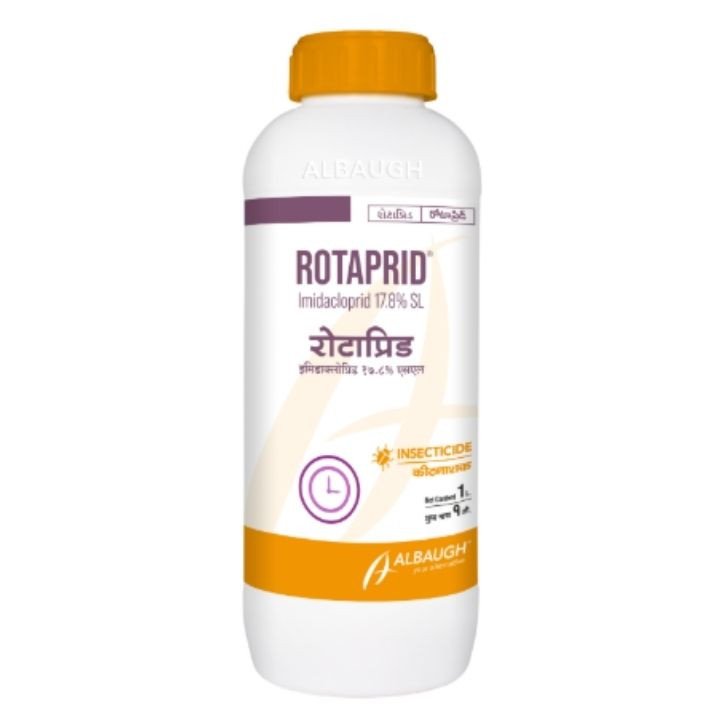

Most farmers understand systemic insecticides move within the plant, but there's a specific directional detail with Rotaprid worth understanding — its acropetal movement. This means the active ingredient, once absorbed, travels upward from the point of uptake toward newer growth points. Practically, this translates into a genuinely useful outcome: foliage that emerges after the spray was applied still receives some level of protection, rather than only the leaves present at the time of spraying being covered.
Built on Imidacloprid 17.8% in a soluble liquid formulation, Rotaprid belongs to the neonicotinoid group — one of the most widely relied-upon insecticide classes for managing sucking pests across Indian field and vegetable crops, largely because of exactly this kind of systemic, growth-following protection.
| Detail | Specification |
|---|---|
| Brand | Albaugh |
| Product Name | Rotaprid |
| Technical Content | Imidacloprid 17.8% |
| Formulation | Soluble Liquid (SL) |
| Insecticide Group | Neonicotinoid |
| Registered Crops | Cotton, Rice, Sunflower, Okra, Groundnut, Chilli, Tomato, Sugarcane |
A crop under sucking pest pressure often keeps producing new leaves and shoots throughout the season, and each new flush is a fresh target for aphids, jassids, or whiteflies looking to establish themselves. A purely contact insecticide only protects the tissue it directly touched at spray time — new growth emerging afterward is essentially unprotected until the next spray round. Rotaprid's acropetal systemic movement changes this dynamic, extending a degree of protection to foliage that develops after application, which can meaningfully reduce how often repeat sprays are needed during active growth phases.
Rotaprid's label splits into two distinct use cases with correspondingly different dose ranges — general sucking pest control across seven crops at a lower dose band, and termite control in sugarcane at a notably higher single rate.
| Crop | Target Pest Type | Dose (per Acre) |
|---|---|---|
| Cotton | Sucking Pests | 40–100 ml |
| Rice | Sucking Pests | 40–100 ml |
| Sunflower | Sucking Pests | 40–100 ml |
| Okra | Sucking Pests | 40–100 ml |
| Groundnut | Sucking Pests | 40–100 ml |
| Chilli | Sucking Pests | 40–100 ml |
| Tomato | Sucking Pests | 40–100 ml |
| Sugarcane | Termites | 140 ml |
The gap between the standard 40–100 ml sucking pest range and sugarcane's 140 ml termite rate reflects a fundamentally different pest biology and exposure route — termites are soil-dwelling pests generally requiring a stronger, more concentrated soil-directed application to achieve adequate control, quite unlike the lighter foliar dose needed for above-ground sucking pests like aphids or jassids.
This 40–100 ml range across seven different crops isn't arbitrary — actual dose selection within that band should reflect the specific crop being treated, pest population density, and infestation severity at the time of application. Lighter infestations detected early generally justify the lower end of the range, while more established sucking pest populations across a larger crop area would call for moving toward the upper limit.
What does "acropetal movement" actually mean for how Rotaprid protects my crop?
It means the active ingredient moves upward from where it's absorbed toward newer growth points, so foliage that emerges after spraying still receives some protective benefit, not just the leaves present at the time of application.
Why is the sugarcane dose (140 ml) so much higher than the sucking pest range (40–100 ml) used for other crops?
Sugarcane's use case targets termites, a soil-dwelling pest requiring stronger, more concentrated application compared to the lighter foliar dose needed for above-ground sucking pests like aphids or jassids on other crops.
Which pests does Rotaprid help control on crops like cotton, tomato, and chilli?
It's recommended for various sucking pests common to these crops, applied at 40–100 ml per acre depending on infestation severity.
Can the same Rotaprid formulation be used for both foliar sucking pest control and sugarcane termite management?
Yes, the same Imidacloprid 17.8% SL formulation covers both uses, though at different dose rates and application approaches suited to each pest type.
Disclaimer: The details provided are for informational guidance only. Always adhere to the recommended application instructions as stated on the product label and in the accompanying leaflet.
No reviews yet.

-(1).png)