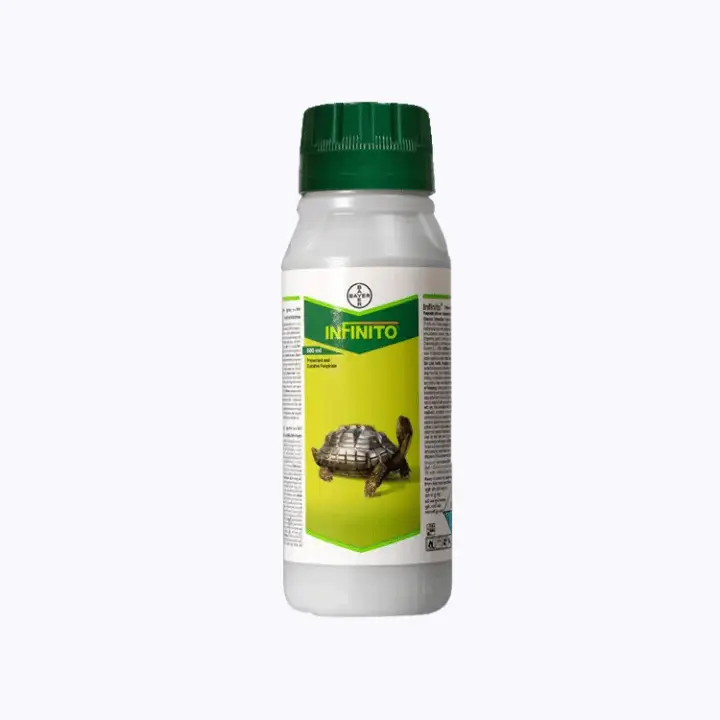

Oomycete diseases like late blight and downy mildew share a dangerous trait — under the right humid, cool conditions, they don't just infect a plant, they explode into an epidemic within days by producing spores that spread rapidly to neighboring plants. Bayer Infinito is built specifically to interrupt this cycle at multiple points, combining Fluopicolide 5.56% and Propamocarb Hydrochloride 55.6% in an SC formulation that works through a genuinely novel mechanism rather than a more conventional fungicidal approach.
Fluopicolide's mode of action is what sets this combination apart — it disrupts the formation of spectrin-like proteins within the pathogen's cell structure, essentially attacking the fungus's architectural integrity at a level most conventional fungicides don't touch. Propamocarb Hydrochloride complements this with systemic activity that limits mycelial growth and reproductive structures like spores, while also influencing membrane synthesis within the pathogen.
| Detail | Specification |
|---|---|
| Brand | Bayer |
| Product Name | Infinito |
| Technical Content | Fluopicolide 5.56% w/w + Propamocarb Hydrochloride 55.6% w/w |
| Formulation | Suspension Concentrate (SC) |
| Mode of Entry | Systemic and Translaminar |
| Toxicity Classification | Blue (Low Toxicity) |
| Application Methods | Foliar Spray, Drone Application |
| Registered Crops | Potato, Tomato, Cucumber, Onion |
A fungicide that only kills existing fungal growth but leaves spore production intact essentially buys a short reprieve — new spores will simply launch the next infection cycle. Infinito's anti-sporulant activity specifically targets this reproductive stage, helping reduce further disease spread beyond just treating the visible infection. Combined with its translaminar movement within plant tissue, this gives Infinito reach beyond just the sprayed surface, addressing infection that may have already progressed into leaf tissue.
| Crop | Target Disease |
|---|---|
| Potato | Late Blight |
| Tomato | Late Blight |
| Cucumber | Downy Mildew |
| Onion | Downy Mildew, Purple Blotch |
| Crop | Target Disease | Dose per Acre | Water Dilution | Per Litre Rate | Waiting Period |
|---|---|---|---|---|---|
| Potato | Late Blight | 500–600 ml | 200 L (Conventional) | 2.5–3 ml | 19 days |
| Potato (Drone) | Late Blight | 62.5–75 ml | 8 L (Drone) | — | 19 days |
| Tomato | Late Blight | 600 ml | 200 L | 3 ml | 5 days |
| Cucumber | Downy Mildew | 600 ml | 200 L | 3 ml | 5 days |
| Onion | Downy Mildew, Purple Blotch | 400–500 ml | 150–200 L | 2–3.33 ml | 25 days |
Potato's drone application rate uses considerably less water volume (8 litres versus 200 litres for conventional spraying) at a correspondingly lower total formulation quantity per acre — this reflects the more concentrated, targeted delivery drone spraying achieves compared to conventional knapsack or power sprayer application, not a difference in effective dose reaching the crop.
For conventional foliar spray, prepare the solution by adding the recommended Infinito quantity to water and mixing thoroughly, using a knapsack sprayer fitted with a hollow cone nozzle for uniform canopy coverage. For drone application specifically in potato late blight management, maintain a 5-metre buffer zone across the field perimeter, and time the first spray as soon as disease symptoms are noticed on leaves, with subsequent sprays at 10–15 day intervals depending on severity.
What is the technical composition of Bayer Infinito?
It contains Fluopicolide 5.56% w/w and Propamocarb Hydrochloride 55.6% w/w in an SC formulation.
Which diseases does Infinito help manage?
It is useful for managing late blight in potato and tomato, downy mildew in cucumber and onion, and purple blotch in onion.
Can Infinito be applied using a drone?
Yes, drone application is specifically available for potato late blight management, using a lower water volume of 8 litres per acre with a corresponding formulation dose.
How many times can Infinito be applied during one crop period?
It should not be used more than two times during a single crop period, as part of resistance management guidance.
Why does the waiting period differ so much between crops (5 days for tomato versus 25 days for onion)?
This reflects different residue clearance profiles and growth cycles across crops, so the specific waiting period for the crop being treated should always be followed precisely.
Disclaimer: The details provided are for informational guidance only. Always adhere to the recommended application instructions as stated on the product label and in the accompanying leaflet.
Product ki quality meri expectation se better nikli.
Overall, main is product se pleased hoon.
Very satisfied.
Happy with delivery speed and quality.
Overall a positive experience with this item.
Product fits well with my current needs.
Happy with both quality and delivery.
Home delivery ka experience accha raha.
Five-star experience.
Good customer service.