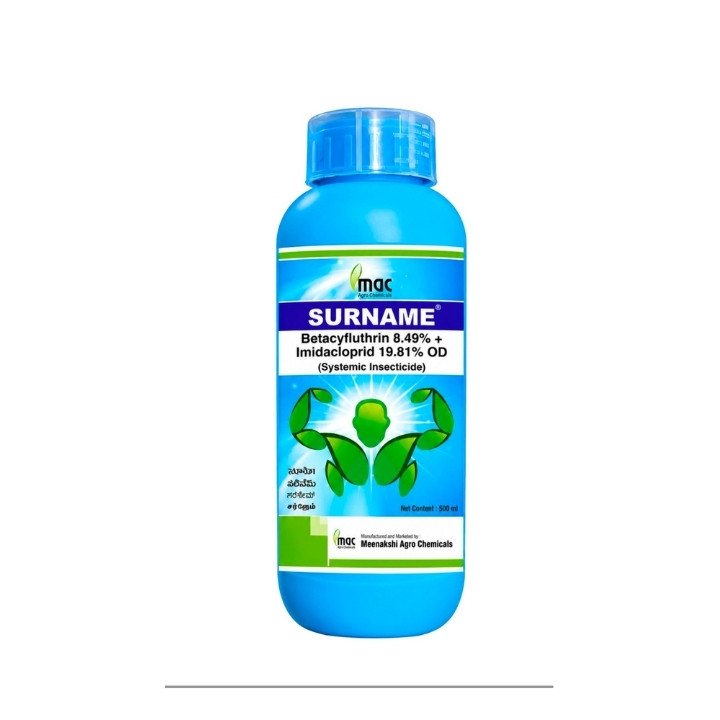

MAC Surname is a dual-action insecticide containing Beta-cyfluthrin 8.49% + Imidacloprid 19.81% w/w OD. It combines contact activity from Beta-cyfluthrin with systemic activity from Imidacloprid for managing label-approved chewing and sucking insect pests.
The formulation is registered in brinjal for the control of aphids, jassids and shoot-and-fruit borer. Its oil-dispersion formulation supports uniform spreading, retention and penetration on treated plant surfaces when applied according to label directions.
Important: Crop registrations can differ between brands containing the same active ingredients. Use MAC Surname only on crops and pests printed on its current container label.
| Specification | Details |
|---|---|
| Product Name | MAC Surname Insecticide |
| Brand | MAC |
| Manufacturer/Marketer | Meenakshi Agro Chemicals |
| Technical Content | Beta-cyfluthrin 8.49% + Imidacloprid 19.81% w/w OD |
| Formulation | Oil Dispersion (OD) |
| Product Type | Contact and systemic insecticide |
| Registered Crop | Brinjal |
| Target Pests | Aphids, jassids and shoot-and-fruit borer |
| Application Method | Foliar spray |
| Registered Dose | 175–200 ml per hectare |
| Water Volume | 500 litres per hectare |
| Waiting Period | 7 days in brinjal |
| Pack Size Shown | 500 ml |
| Active Ingredient | Concentration | Primary Activity |
|---|---|---|
| Beta-cyfluthrin | 8.49% w/w | Contact and ingestion activity with rapid knockdown |
| Imidacloprid | 19.81% w/w | Systemic activity against susceptible sucking pests |
| Formulation ingredients | Quantity sufficient to make the oil-dispersion formulation | |
MAC Surname combines two insecticidal modes of action. Beta-cyfluthrin is a synthetic pyrethroid that affects voltage-gated sodium channels within the insect nervous system. This causes prolonged nerve stimulation, loss of coordination, paralysis and death in susceptible insects.
Imidacloprid is a neonicotinoid insecticide that binds to nicotinic acetylcholine receptors in the insect nervous system. It causes continuous nerve stimulation, feeding cessation, paralysis and eventual death.
| Active Ingredient | IRAC Group | Target Site |
|---|---|---|
| Beta-cyfluthrin | Group 3A | Sodium-channel modulator |
| Imidacloprid | Group 4A | Nicotinic acetylcholine-receptor competitive modulator |
| Crop | Target Pests | Dose per Hectare | Approx. Dose per Acre | Water per Hectare | Waiting Period |
|---|---|---|---|---|---|
| Brinjal | Aphids, jassids and shoot-and-fruit borer | 175–200 ml | Approximately 70–80 ml | 500 litres | 7 days |
Dose-conversion note: The acre dose is a rounded conversion from the registered hectare recommendation. Measure according to the actual treated area and follow the current MAC Surname label.
| Calculation | Approximate Quantity |
|---|---|
| Per litre at 175 ml in 500 litres | 0.35 ml per litre |
| Per litre at 200 ml in 500 litres | 0.40 ml per litre |
| For a 15-litre pump | Approximately 5.25–6 ml |
Per-litre and pump calculations assume the registered water volume of 500 litres per hectare. Field application should be calibrated according to treated area rather than increasing concentration to compensate for low water volume.
| Application Rate | Approximate Area Covered |
|---|---|
| 175 ml per hectare | Approximately 2.85 hectares or 7 acres |
| 200 ml per hectare | Approximately 2.5 hectares or 6.2 acres |
Pack coverage is a mathematical estimate. Actual coverage depends on the crop, pest, selected label rate, sprayer calibration and treated field area.
Aphids feed on plant sap and may cause curling, yellowing, sticky honeydew and reduced plant vigour. Imidacloprid provides systemic activity against susceptible aphid populations.
Jassids feed from the underside of leaves and may cause yellowing, curling and hopper-burn symptoms. Timely application helps manage susceptible populations before severe foliage damage develops.
Young larvae initially damage tender shoots and later bore into developing fruits. Application should target eggs and young larvae before extensive penetration into shoots or fruits occurs.
MAC Surname contains IRAC Group 3A and Group 4A insecticides. Repeated use of the same combination can select resistant pest populations.
This active-ingredient combination can be highly toxic to honey bees, aquatic organisms and freshwater fish. Strict drift, runoff and pollinator-protection measures are necessary.
Mix MAC Surname with another pesticide or fertilizer only when the labels of all products permit the combination. Conduct a small jar test before preparing an unfamiliar tank mixture.
Do not spray a mixture that produces sediment, flakes, excessive foam, heat or separation. Compatibility does not automatically establish crop safety or biological effectiveness.
MAC Surname is registered in brinjal for controlling aphids, jassids and shoot-and-fruit borer.
It contains Beta-cyfluthrin 8.49% + Imidacloprid 19.81% w/w in an oil-dispersion formulation.
The rounded equivalent dose is approximately 70–80 ml per acre in brinjal. This is converted from the registered rate of 175–200 ml per hectare.
Approximately 5.25–6 ml per 15-litre pump when maintaining the registered concentration of 175–200 ml in 500 litres of water.
At the registered brinjal rate, the 500 ml pack can treat approximately 2.5–2.85 hectares or about 6.2–7 acres.
It provides both activities. Beta-cyfluthrin supplies contact and ingestion action, while Imidacloprid supplies systemic activity.
Yes. Its brinjal registration includes aphids and jassids as sucking pests and shoot-and-fruit borer as a chewing pest.
Observe a waiting period of 7 days between the final spray and harvesting.
Avoid spraying while honey bees and other pollinators are actively foraging. Follow the environmental and pollinator precautions printed on the label.
Other brands with the same active ingredients may have additional crop registrations. Use MAC Surname on another crop only if that crop and its dose are specifically printed on the current MAC Surname label.
Disclaimer: This information is provided for general agricultural guidance only. Always follow the current product label for approved crops, pests, dosage, water volume, application frequency, waiting period, environmental precautions and safety instructions.
No reviews yet.